




Greyshark AUV: 112‑Day Underwater Drone Guards NATO Cables
Greyshark AUV: 112‑Day Underwater Drone Guards NATO Cables
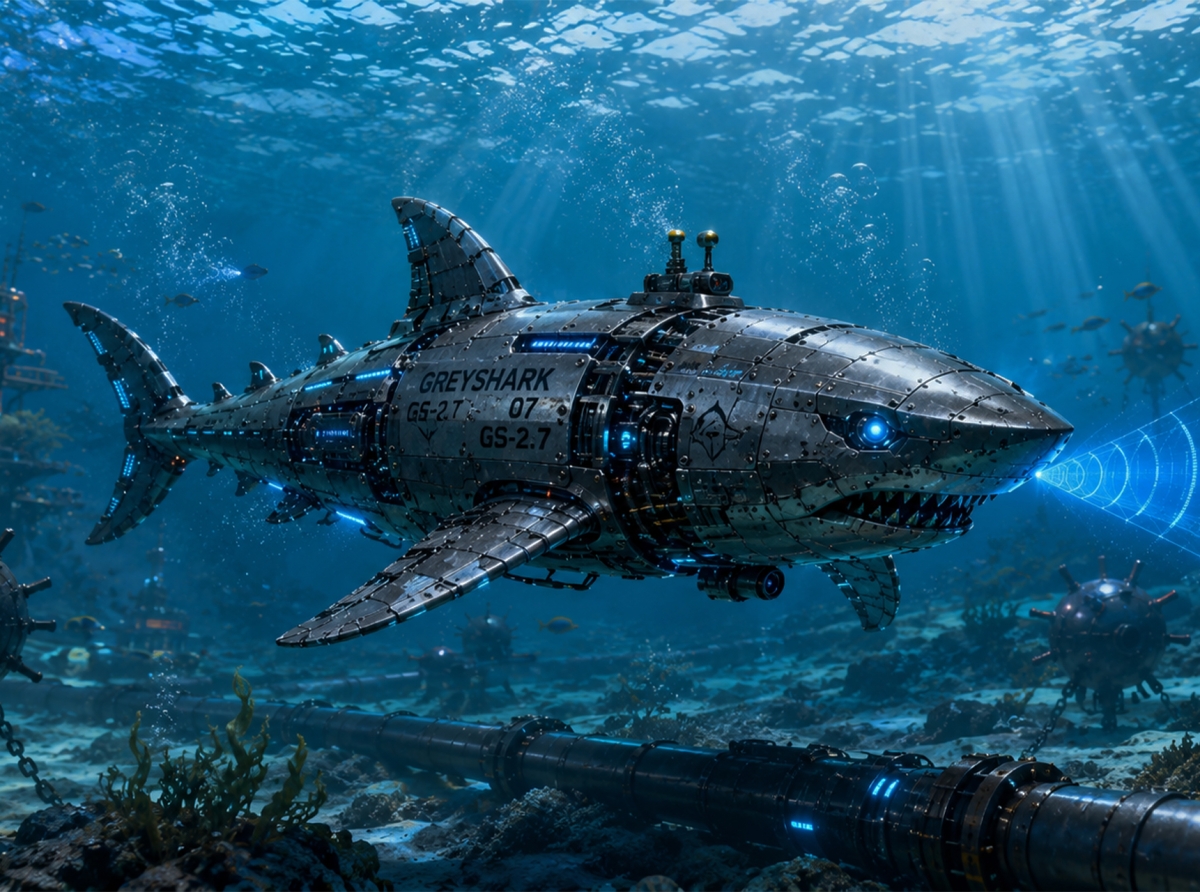
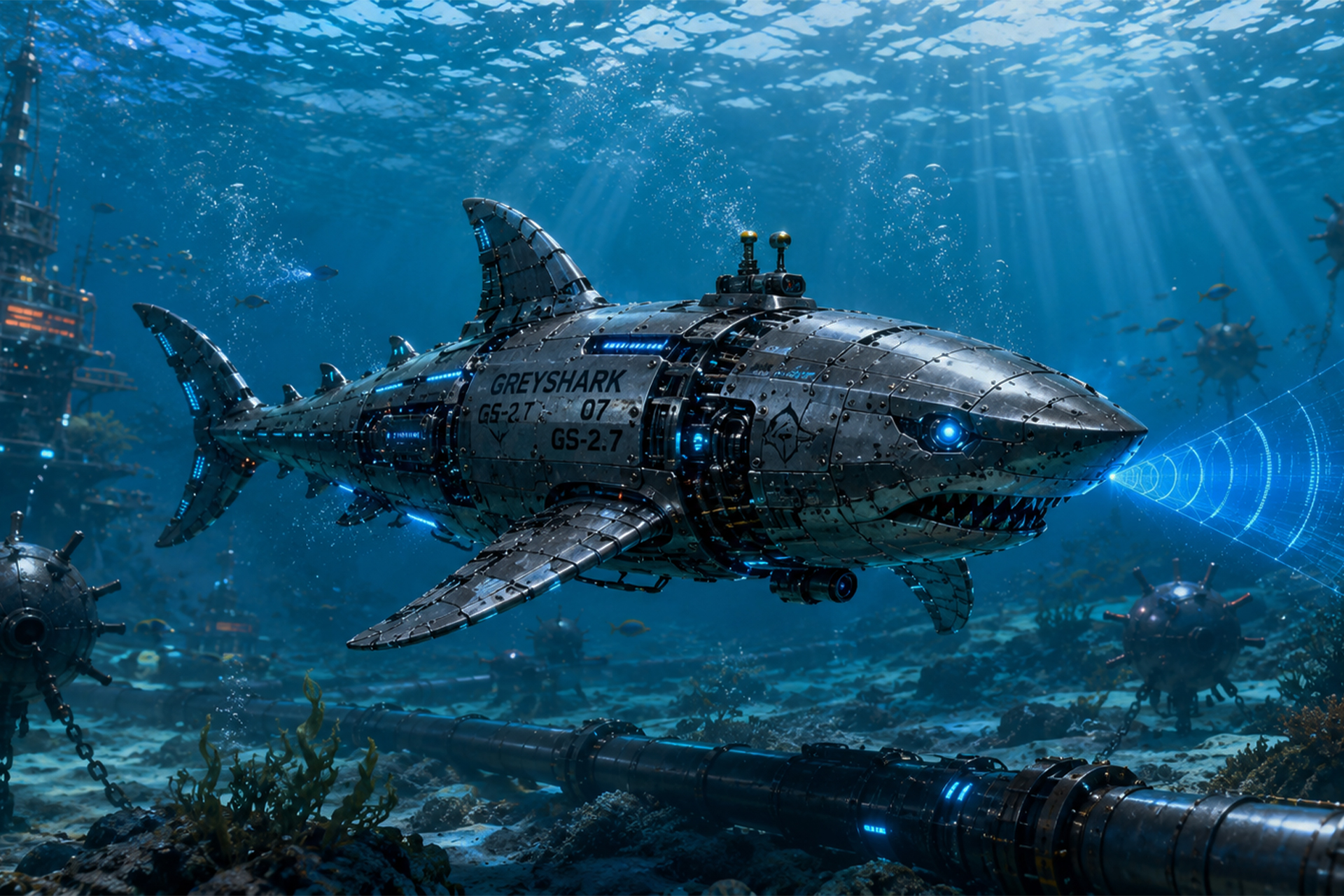
The Bremen‑based defence technology company Euroatlas has unveiled Greyshark, an autonomous underwater vehicle (AUV) that can remain submerged for up to 16 weeks without a support vessel. Powered by hydrogen fuel cells, the drone can travel 1,100 nautical miles at 10 knots or 10,700 nautical miles at 4 knots, making it the longest‑endurance AUV in its class. Greyshark carries 17 high‑resolution sensors capable of generating seabed images with a resolution of 1.6 inches per pixel. The vehicle can independently dive, navigate to mission areas, conduct search patterns, detect and report objects, and complete mine warfare tasks.
According to Euroatlas’ head of strategy Verineia Codrean, six Greyshark units operated by a single person could map the entire Strait of Hormuz in less than 24 hours – a task that would take manned assets far longer and at much greater risk. The system has attracted significant interest from NATO nations and is scheduled for official sea trials in August 2026.
According to Euroatlas’ head of strategy Verineia Codrean, six Greyshark units operated by a single person could map the entire Strait of Hormuz in less than 24 hours – a task that would take manned assets far longer and at much greater risk. The system has attracted significant interest from NATO nations and is scheduled for official sea trials in August 2026.
Greyshark’s endurance advantage comes from its hydrogen fuel cell propulsion, which produces electricity through an electrochemical reaction without combustion. The “Foxtrot” variant, designed for long‑duration intelligence, surveillance, and reconnaissance missions, can remain submerged for approximately four months at a time. This capability fundamentally changes underwater operations that were previously impractical or too costly. At a cruising speed of 10 knots, the AUV has a range of roughly 1,000 nautical miles.
When speed is reduced to 4 knots for endurance missions, the range expands to an incredible 10,700 nautical miles. The vehicle’s maximum speed exceeds 12 knots, making it the fastest AUV in its class. The battery‑powered “Bravo” variant, by contrast, has an endurance of approximately five days and a maximum range of about 550 nautical miles, suitable for shorter‑term tasks such as harbour patrols or minelaying missions.
The Foxtrot’s hydrogen system allows it to operate silently, with a flooded‑hull design and non‑metallic composite construction that minimises sonar cross‑section and electromagnetic signature. Operating constantly at maximum speed of 10 knots reduces endurance to six days, but the AUV is designed primarily for long, slow persistence rather than high‑speed transit.
The platform is currently rated to a depth of 650 metres, with future iterations targeting 4,000 metres.
When speed is reduced to 4 knots for endurance missions, the range expands to an incredible 10,700 nautical miles. The vehicle’s maximum speed exceeds 12 knots, making it the fastest AUV in its class. The battery‑powered “Bravo” variant, by contrast, has an endurance of approximately five days and a maximum range of about 550 nautical miles, suitable for shorter‑term tasks such as harbour patrols or minelaying missions.
The Foxtrot’s hydrogen system allows it to operate silently, with a flooded‑hull design and non‑metallic composite construction that minimises sonar cross‑section and electromagnetic signature. Operating constantly at maximum speed of 10 knots reduces endurance to six days, but the AUV is designed primarily for long, slow persistence rather than high‑speed transit.
The platform is currently rated to a depth of 650 metres, with future iterations targeting 4,000 metres.
Greyshark AUV: 112‑Day Underwater Drone Guards NATO Cables
What the 17 Sensors Can See – And Why That Matters for NATO
Greyshark carries a sensor suite of 17 modules, including synthetic aperture sonar (SAS), multibeam echo sounders, optical sensors, electromagnetic scanners, LiDAR, and multispectral AI‑powered cameras. These sensors generate seabed imagery at a resolution of approximately 1.6 inches per pixel – roughly 4 centimetres – enabling precise identification of underwater hazards, mines, damaged cables, or unauthorised objects.The system uses onboard artificial intelligence for real‑time sensor fusion, combining data from different frequency bands and sensor types to produce a more detailed environmental picture than any individual sensor could achieve alone. Markus Beer, Euroatlas’ chief sales officer for AUVs, told Newsweek that the drone can detect changes as small as two square centimetres in a section of cable or pipeline – sufficient to identify early signs of corrosion, sabotage, or accidental damage.
For mine countermeasures, the AUV can autonomously search for and classify mines, then report their positions without human intervention. The system has already been tested in the Baltic Sea off the northern German coast, where NATO nations are heavily investing in anti‑submarine warfare and critical infrastructure protection. The sensors also enable the drone to track underwater activity across large maritime zones, providing persistent maritime awareness – something that Eugen Ciemnyjewski, Euroatlas’ managing director, notes is “simply impossible to achieve with only manned assets”.
Why Six Greyshark Units Could Clear the Strait of Hormuz in 24 Hours
The strategic value of Greyshark becomes clear in contested chokepoints such as the Strait of Hormuz. In mid‑April 2026, Iran deployed naval mines in the strait but later struggled to locate them. “Even the Iranian authorities don’t know where the mines are,” Codrean told Interesting Engineering. “Clearing the Strait with manned assets would be extremely difficult, expensive, and dangerous”.A single operator controlling six Greyshark vehicles could precisely map the entire strait in no more than 24 hours. “No manned asset would be able to do it that fast, and autonomy also makes the mission much safer,” she added. The swarm capability is a core design feature. Greyshark units can operate in groups of up to six, coordinated through encrypted underwater acoustic communication developed by EvoLogics, which is based on dolphin‑like sound transmission.
The swarm can distribute tasks in real time, share data, and adjust behaviour based on mission rules without surfacing. The AUV can also sit passively on the seabed and activate only when a specific vessel class is identified, then approach under active sensors or quietly withdraw and report.
Beyond mine clearance, Greyshark is designed to detect narco‑submarines – semi‑submersible and fully submersible vessels used by drug cartels to transport cocaine from South America to North America and Europe. “Autonomous systems can very quickly identify possible paths and generate thousands of search combinations,” Codrean noted.
NATO’s Interest and the Race to Protect Underwater Infrastructure
Several European members of NATO are considering acquiring Greyshark to protect critical undersea infrastructure, including energy pipelines and communication cables, and to hunt submarines. The alliance launched its Baltic Sentry initiative in January 2025, increasing the presence of frigates and maritime patrol aircraft after several undersea cables were cut or damaged in late 2024. Eugen Ciemnyjewski, Euroatlas’ managing director, said multiple NATO nations had expressed interest in the AUVs, and Asian customers are also considering the technology.The German military has described the drone as a “useful asset”. The Foxtrot variant can cover 4,800 square kilometres of seabed in each four‑month deployment, and a swarm of six drones would be aware of the location of vital infrastructure to quickly detect any changes to pipelines or cables.
The drone is designed to work alongside NATO vessels, particularly in anti‑submarine warfare. An AUV moving ahead of a ship may pick up a signal from a Russian submarine and relay it back to the larger platform for targeting. A swarm can also form a “protective shield” around high‑value assets. The German defence company Rheinmetann has partnered with Euroatlas to integrate Greyshark into its digital battle architecture, Battlesuite, as part of a comprehensive, digitally networked coastal defence system.
The collaboration emphasises a European production and logistics chain to ensure sovereignty and security of supply.
Original expert insight: The Greyshark programme represents a significant shift in naval doctrine. Traditionally, underwater domain awareness required expensive, crewed platforms with limited endurance. Hydrogen fuel cell AUVs like Greyshark decouple presence from human risk and operational cost.
For NATO, the ability to maintain persistent, wide‑area surveillance over key chokepoints and cable routes without risking submarines or surface vessels changes the calculus of hybrid warfare. However, the same technology that protects undersea cables could also be used for covert intelligence gathering or even offensive mining – raising questions about escalation and the need for new rules of engagement for fully autonomous systems.
The August 2026 trials will test not just endurance but also the reliability of encrypted swarm communications and the safety of operating armed or mine‑countermeasure variants near civilian shipping lanes.
Regional Perspectives on Greyshark Deployment
For European NATO members, the Baltic Sea is the most immediate testbed. The region has seen multiple suspicious incidents involving undersea cables, and Russia’s Kaliningrad exclave hosts the Kremlin’s Baltic fleet.The Greyshark’s ability to operate autonomously for months without a support vessel makes it well‑suited to monitoring this contested area, where a persistent surface presence is politically and logistically difficult. The German government’s maritime coordinator, Dr Christoph Ploss, has already inspected the Foxtrot variant during Baltic trials.
In the Middle East, the Strait of Hormuz remains a high‑risk corridor for global energy trade. A swarm of six Greyshark units could provide continuous mine detection and infrastructure monitoring without exposing crews to asymmetric threats. In the Asia‑Pacific region, where underwater cable networks are dense and contested, interest from Asian customers suggests similar applications.
The drone’s 4,000‑metre depth target for future versions would enable deep‑sea cable inspection and seabed warfare operations that are currently beyond the reach of most AUVs. For the United States, Greyshark complements existing undersea systems while offering an ITAR‑exempt European alternative that can be exported without US authorisation, easing interoperability within NATO and with other allies.
What the August 2026 Trials Will Validate
Greyshark is scheduled for official sea trials in August 2026. The testing will validate the AUV’s navigation systems, sensor accuracy, and full endurance capabilities in real‑world conditions. The Foxtrot variant began in‑water testing in April 2026 off the German coast near Kiel and Rostock, reaching technology readiness level four, meaning the propulsion and systems had previously only been tested on land. The upcoming trials will focus on swarm coordination, long‑duration autonomy without communication, and sensor fusion performance in challenging underwater environments with murk, currents, and variable bathymetry.Euroatlas plans to increase production capacity to 150 Greyshark units per year by 2026. If the trials succeed, the drone could move from testing to operational deployment within months, rather than the years typically required for naval programmes. The company has already demonstrated speed: Greyshark moved from concept to first order in less than two years.
For navies facing budget pressures and personnel shortages, that pace of innovation is as valuable as the technology itself.
Euroatlas’ Greyshark redefines what an autonomous underwater vehicle can achieve. Powered by hydrogen fuel cells and equipped with 17 AI‑driven sensors, it can remain submerged for 112 days without resupply, covering thousands of nautical miles while detecting threats as small as two square centimetres on a pipeline.
Six units working as a swarm can map the entire Strait of Hormuz in 24 hours – a mission that would otherwise risk crews and take significantly longer. NATO’s growing interest reflects a broader shift toward persistent, unmanned maritime awareness in contested zones.
The August 2026 trials will determine whether Greyshark transitions from prototype to standard equipment.
For defence investors and maritime security analysts, the signal is clear: the era of affordable, long‑endurance underwater drones has arrived. The question is no longer whether navies will deploy them, but how quickly rules of engagement can adapt to a seabed patrolled by machines.
Six units working as a swarm can map the entire Strait of Hormuz in 24 hours – a mission that would otherwise risk crews and take significantly longer. NATO’s growing interest reflects a broader shift toward persistent, unmanned maritime awareness in contested zones.
The August 2026 trials will determine whether Greyshark transitions from prototype to standard equipment.
For defence investors and maritime security analysts, the signal is clear: the era of affordable, long‑endurance underwater drones has arrived. The question is no longer whether navies will deploy them, but how quickly rules of engagement can adapt to a seabed patrolled by machines.
By Jake Sullivan
May 20, 2026
Join us. Our Telegram: @forexturnkey
All to the point, no ads. A channel that doesn't tire you out, but pumps you up.
May 20, 2026
Join us. Our Telegram: @forexturnkey
All to the point, no ads. A channel that doesn't tire you out, but pumps you up.





Report
My comments