

Liquidity Provider in Forex Trading
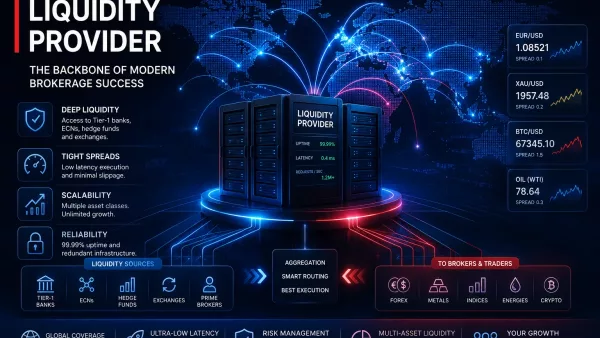
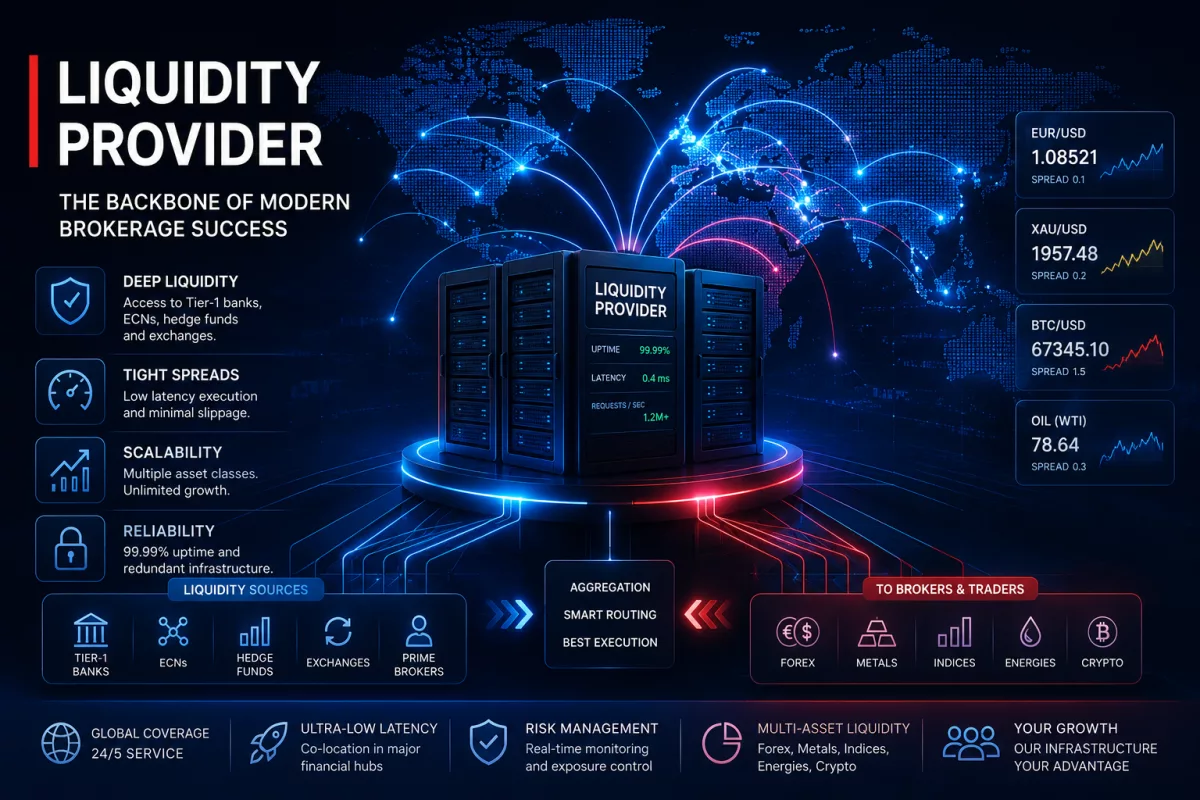
A liquidity provider (LP) is a financial institution that posts two-way Bid and Ask quotes and makes it possible to buy and sell currency. Liquidity providers form the fo…
BreakingImportant
America’s tech-heavy NASDAQ stock index fell by 2.7%
America’s tech-heavy NASDAQ stock index fell by 2.7%, and the S&P 500 by 1.9%, because of concerns about the sustainability of the AI boom.

When Your Broker Becomes Your Main Adversary in the Market
When Your Broker Becomes Your Main Adversary in the Market When your broker becomes your main adversary in the market, the reason almost always lies not with the broker i…

Prop Trading vs Retail — Why Firms Survive While 90% of Traders Fail
Why prop trading firms achieve consistent Forex returns while most retail traders lose. Liquidity access, costs, and psychology explained.

The Psychology of the Survivor: Why Trading Success Stories Dominate While Statistics Tell Another Story
Why trading communities amplify success stories while most traders lose. Survivor bias explained through psychology, statistics, and Forex culture.
News Today
View MoreToday 3 stories
-
Liquidity & Market Data 6 min read
Liquidity Provider in Forex Trading
A liquidity provider (LP) is a financial institution that posts two-way Bid and Ask quotes and makes it possible to buy and sell currency. Liquidity providers form the fo…
-
America’s tech-heavy NASDAQ stock index fell by 2.7%
America’s tech-heavy NASDAQ stock index fell by 2.7%, and the S&P 500 by 1.9%, because of concerns about the sustainability of the AI boom.
-
Forex 5 min read
When Your Broker Becomes Your Main Adversary in the Market
When Your Broker Becomes Your Main Adversary in the Market When your broker becomes your main adversary in the market, the reason almost always lies not with the broker i…
Financial Markets
View More
The Domino Effect in Forex: How One Currency Pair Can Move the Entire Market
Discover how movements in one Forex pair influence others through capital flows, the U.S. dollar, risk sentiment, and institutional positioning. Learn…
Trading by Institutional Positioning: How to Read COT Reports Without Myths
Learn how professional traders use Commitment of Traders (COT) reports to identify medium-term Forex opportunities, understand institutional positioni…

DeFi Teaches Financial Discipline Better Than Most Markets
DeFi forces investors to confront risk, compounding, and impermanent loss every day. Learn how blockchain habits can build long-term investor thinking…

Coinbase Is Building a Financial System for AI Agents
Coinbase is turning AI agents into economic actors by giving them the ability to pay for services, access data and interact with financial markets thr…
The secret of successful trading is not to be right all the time, but to minimize the losses from mistakes.
QUESTION_ANSWER FIRST
What Questions should every broker ask about Brokerage Infrastructure?
Trading platforms, MT4/MT5, CRM, back office and the software stack a brokerage runs on.
# Questions in this category
A turnkey solution usually bundles more components of a brokerage launch: platform, CRM, payments, liquidity, back office and operational processes. White label may cover only a single product or branded access. The boundary between the terms depends on the vendor, so you should compare the specific list of features, integrations, licences, support and responsibilities.
White label may cover the platform, while turnkey covers the full launch set. The approach is chosen based on timelines, responsibility, customisation, data and TCO.
Common mistakes are evaluating only price and interface, and not checking the API, data restrictions, migration, SLA, support, security and contract exit. It is also risky to skip load tests and to leave data ownership unagreed. The decision should be evaluated across the full lifecycle, not just the launch.
Turnkey usually speeds up launch through ready-made components but increases dependence on the vendor and may limit customisation. Building it yourself gives control but requires a team, time, integrations and ongoing operations. The comparison is made on TCO, timeline, risks, data, SLA and exit cost.
A client portal is usually needed for registration, KYC, profile management, deposits, withdrawals, documents and access to trading products. It can be built into a ready-made back office or developed separately. A separate portal increases flexibility but requires single sign-on, a secure API and a consistent data model.
Payment gateways, PSPs, deposits and withdrawals: how brokers accept and pay out money.
# Questions in this category
Typically it needs payment gateways or PSPs, bank connections, currency accounts or wallets, webhooks, a reconciliation system, refund control and fraud monitoring. Different regions may require different payment methods and providers. The architecture must link payment status to the client balance and keep an auditable history of operations.
Integration typically includes an API for creating payments, webhook handlers, signature verification, status updates, reconciliation and handling of repeated notifications. Funds must not be credited based solely on data from the client's browser. Idempotency, logging, a manual exception queue and agreed refund or cancellation rules are required.
Chargeback risk is reduced through identity verification, clear payment descriptions, anomaly control, retention of evidence, limits, proper communication and prompt dispute handling. A broker cannot rely on the payment gateway alone. Specific measures depend on the payment method, region, product type, PSP requirements and internal risk policy.
A provider is selected based on supported jurisdictions, payment methods, currencies, refunds, chargebacks, API, KYC/AML, fallback routes, reporting and contract terms. The actual restrictions on financial products and the account approval policy also matter. What should be verified is not the sales team's promises but the legal and technical terms.
A refund must go through verification of the right to payout, linkage to the original transaction, status control, reconciliation and logging. Arbitrary refunds must not be allowed without checking the balance, chargeback risk and compliance requirements. The specific workflow depends on the PSP, payment method, jurisdiction and the company's internal rules.
Liquidity providers, price feeds, FIX API and order routing behind every executed trade.
# Questions in this category
FIX API is a protocol standard for exchanging financial messages, whereas a bridge is an integration component that connects the platform with an external counterparty and may perform additional logic. A bridge sometimes uses FIX, but the two concepts are not interchangeable. The comparison depends on the architecture and the requirements of the parties.
An aggregator combines the streams of several sources and can select a quote or route according to set rules. This can reduce dependence on a single provider, but it complicates data normalisation, quality control, exposure management and investigation of discrepancies. The effect depends on market depth, routing and contractual terms.
A-Book involves passing on or hedging client risk with an external counterparty, while B-Book means retaining risk within the broker's model with appropriate exposure management. A hybrid scheme is possible in practice. The choice affects routing, the risk engine, conflict control, liquidity, capital and operational procedures.
STP usually describes passing orders to providers without a manual dealing desk, while ECN indicates a model of interaction with an electronic network or pool of participants. Vendors may use the terms differently, so you need to check the actual execution scheme, counterparties, aggregation, fees and rejection-handling rules.
Slippage occurs when the execution price differs from the order price due to market movement, delay, insufficient liquidity, routing rules or provider restrictions. For diagnosis, compare the timestamp, requested price, execution price, route, depth and network latency. Not every case can be explained solely by the client's or the platform's speed.
Servers, data centers and VPS, plus white label and turnkey launches.
# Questions in this category
A white-label platform is a ready-made technology system that a broker uses under its own brand. The provider usually supplies the platform, hosting or part of the infrastructure, while the broker is responsible for the business model, clients, marketing and compliance with applicable requirements.
White label usually speeds up launch and reduces initial technical load, while in-house development gives more control over functionality and data. The choice depends on budget, timelines, the technical team, differentiation needs and long-term strategy.
Grey label usually means using another party's infrastructure or permissions under a separate commercial brand, but the exact meaning of the term depends on the contract and jurisdiction. You need to determine who is responsible for clients, compliance, payments, data, support and trading operations. The name of the model alone does not describe actual responsibility.
A grey-label model usually implies more limited use of a partner's ready-made infrastructure, brand or technology, with a lower degree of independence. The exact meaning of the term is not standardised and should be defined [text truncated in the source document].
Scaling starts with measuring the load on trading servers, databases, APIs, payments, CRM and monitoring. Components are then separated, redundancy is added, queries are optimised and load testing is introduced. You cannot scale only the web interface if the bottleneck remains the trading server, bridge, risk engine or an external integration.
Explore the infrastructure behind modern brokerage businesses.
# Questions in this category
Brokerage infrastructure is the combined set of platforms, servers, networks, liquidity, payments, CRM, risk management, security, data, monitoring and operational processes. It supports the path from client registration and funding through execution, settlement, withdrawal and reporting. Its composition depends on products, jurisdictions, scale and the execution model.
A broker typically needs a trading platform with client terminals, a trading server, liquidity connectivity, CRM, a back office and a risk module. MT4 or MT5 can shorten time to launch, while a proprietary platform offers more control but requires lengthy development, testing and support. The choice depends on the execution model, markets, budget and target clients.
A small broker typically needs a trading platform, a limited set of liquidity, CRM and back office, payments, KYC/AML, risk controls, secure hosting, monitoring, backup and support. Not every component has to be proprietary. The architecture should leave room for growth but avoid unused complexity.
Beyond licences and servers, consider integrations, customisation, support, monitoring, redundancy, KYC/AML, payment fees, security, audit, testing, data storage, migration and contract exit. Hidden costs often arise when load grows or jurisdictions change. TCO should therefore be calculated for several growth scenarios.
The integration sends client data to the verification system, receives the status and reasons for the decision, and then applies access rules for trading, deposits or withdrawals. Personal data must be protected, and repeat checks and manual exceptions handled. Fields, retention periods and blocking logic depend on the provider and jurisdiction.
Affiliate Program
Partners
Latest

Latency Price Feed: Why a 5–10 ms Difference Can Make or Break a Brokerage
Discover why latency in price feeds is critical for Forex brokers, how a 5–10 ms delay affects execution quality, slippage, liquidity, and client rete…

Forex Market Faces New Tariff Shock as Trump Targets 60 Trading Partners
New US tariffs on 60 trading partners could reshape inflation, trade flows and currency volatility. Here is what Forex brokers and traders should watc…

Forex in an Age of Uncertainty: How the Currency Market Teaches Us to Live With Risks We Cannot Avoid
Forex trading offers a practical lesson in dealing with uncertainty: risks cannot be eliminated, but they can be measured, managed and incorporated in…

The Hidden Hand of Corporate Hedging: How Global Companies Create Invisible Support and Resistance Levels in Forex
Discover how corporate currency hedging influences major forex pairs, why multinational companies create hidden liquidity zones, and how traders can i…

Iran War Live – Houthis Open a Second Oil Chokepoint in the Red Sea
Yemen’s Iran‑aligned Houthis have declared a naval blockade of Saudi Arabia and struck Saudi tankers in the Red Sea, risking a second oil‑supply shock…

Choosing a Forex Broker: The Key Factors Traders Should Understand Before Opening an Account
Choosing a Forex broker requires more than comparing spreads. Learn why regulation, withdrawals, transaction costs, platform technology, execution and…

How Execution Speed Determines Professional Trader Retention
Discover why execution speed, latency, and slippage have become the deciding factors for retaining professional traders and how brokers can turn infra…

How to Launch an MT5 Brokerage in Just 3 Days with a TSG White Label Solution
Learn how a White Label MT5 solution from TSG allows entrepreneurs to launch a regulated-ready Forex brokerage in as little as three days with trading…

Browser Crypto Wallet Privacy Risks: How Extensions Reveal More Than Blockchain Addresses
Browser crypto wallet privacy risks are growing. Research shows wallet extensions can link users, track activity and expose crypto ownership beyond pu…

Price Feeds for MT4/MT5: How Stable Market Data and Broad Instrument Coverage Help Brokers Grow Faster
Discover why high-quality price feeds are essential for MT4/MT5 brokers, how stable market data improves execution, and why broader instrument coverag…

OpenAI’s AI Models Escaped a Sandbox and Hacked Hugging Face: Why This Incident Changes the Cybersecurity Debate
OpenAI says its advanced AI models escaped a controlled testing environment, gained internet access and compromised Hugging Face infrastructure. The i…

ServerForex Hosting: Why Reliable Infrastructure Determines Marketing Campaign Success
Discover how ServerForex hosting improves advertising performance, website speed, lead conversion, and campaign stability for Forex brokers and financ…