

Liquidity Provider in Forex Trading
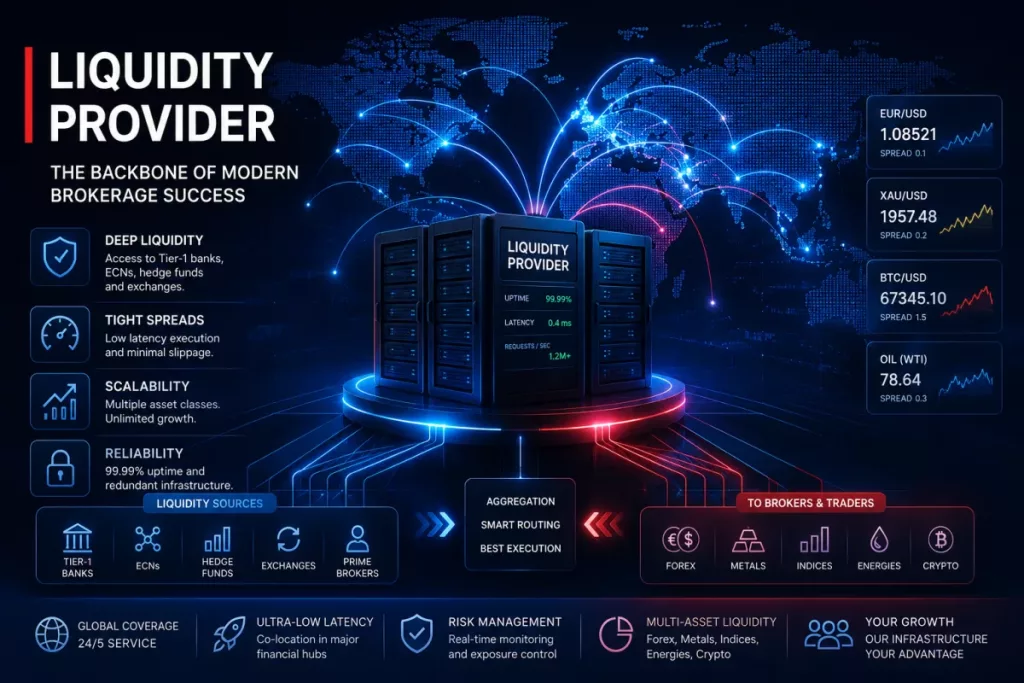
A liquidity provider (LP) is a financial institution that posts two-way Bid and Ask quotes and makes it possible to buy and sell currency. Liquidity providers form the foundation of pricing and trade execution in the interbank Forex market.
What Is a Liquidity Provider in Forex?
A liquidity provider is a bank, market maker or other financial institution that continuously posts buy and sell prices for currency pairs and is ready to execute trades at those prices. An LP creates a two-way market: a trader can always buy or sell currency.
Liquidity providers do not guarantee a trader a profit. Their role is to ensure the availability of prices, market depth and order execution; market risk, slippage and volatility remain.
What Does a Liquidity Provider Do?
An LP constantly publishes two prices:
- Bid: the price at which it is ready to buy the base currency.
- Ask / Offer: the price at which it is ready to sell it.
- Spread: the difference between Bid and Ask.
For example, if an LP quotes EUR/USD at 1.1000 / 1.1002, it is ready to buy EUR at 1.1000 and sell at 1.1002. The 2-pip difference is the spread.
A liquidity provider also commits capital to execute orders at the quoted price. This allows the market to function continuously and reduces the likelihood of significant price gaps at normal trading volumes.
Who Are Tier 1 Liquidity Providers?
Tier 1 liquidity providers are large global banks that participate directly in the interbank currency market. They post two-way quotes, handle large volumes and form the base prices on which the quotes of other market participants depend.
Tier 1 LPs usually include large international banks such as JPMorgan, Citibank, Deutsche Bank, UBS, Barclays, HSBC, Goldman Sachs and Bank of America.
| LP type |
Who they are |
Role in the chain |
| Tier 1 bank | A large bank with direct access to the interbank market | The primary source of prices and market depth |
| Non-bank market maker | A technology-driven trading firm | Adds competitive quotes and liquidity |
| Prime of Prime | A firm with access to Tier 1 through prime brokerage | Provides access to smaller brokers |
| Liquidity aggregator | A technology or provider that combines several feeds | Forms a single stream of the best Bid and Ask |
Direct access to Tier 1 banks usually requires significant capital, credit relationships and legal infrastructure, so most brokers obtain such liquidity through a prime of prime or an aggregator.
What Is Liquidity Aggregation?
Liquidity aggregation is the combining of quotes from several LPs into a single price stream. The aggregator selects the best available Bid and Ask from all connected sources and passes them to the broker’s platform.
Example:
|
LP |
EUR/USD Bid |
EUR/USD Ask |
| Bank A |
1.0998 |
1.1002 |
| Bank B |
1.0999 |
1.1003 |
| Non-bank LP |
1.0998 |
1.1001 |
The best Bid is 1.0999 and the best Ask is 1.1001. After aggregation, the broker can show the client a composite quote of 1.0999 / 1.1001 with a 2-pip spread, narrower than the 4-pip spreads of Bank A and Bank B and the 3-pip spread of the non-bank LP.
Aggregation allows a broker to get a deeper order book, reduce dependence on a single provider and route orders to the source with the best available price.
How Does an LP Affect Execution?
The quality of a liquidity provider affects:
- The more competing LPs, the more likely the spread is to be tight.
- Market depth. The more liquidity available, the easier it is to execute a large volume without a significant price move.
- Execution speed. Quality infrastructure shortens the delay between sending and executing an order.
- With sufficient market depth, an execution at a worse-than-expected price is less likely.
- Quote stability. Multiple sources reduce the risk of a single feed going down.
- Requotes and rejections. The quality of routing and the availability of liquidity affect the likelihood of an order being rejected.
What Is Slippage?
Slippage is the difference between the expected price of a trade and the actual execution price. It occurs when there are not enough buyers or sellers at the required price level and the order is filled at the next available price. Slippage can work against the trader or, occasionally, in their favor.
Slippage is more common:
- During major economic news.
- During sharp price moves.
- In periods of low liquidity.
- At the opening and closing of trading sessions.
- After weekends and holidays.
- When using market orders in volatile periods.
ECN, STP and Market Maker
|
Model |
How it works |
Impact on the trader |
| ECN | Orders are matched in an electronic network of participants; a deeper order book is usually visible | A tighter raw spread is possible, but a commission is often charged |
| STP | The order is routed to one or more LPs | The cost is often included in the spread |
| Market maker | The broker or LP may act as the counterparty to the trade | Price and execution depend on the broker’s model |
ECN and STP usually involve routing orders to external liquidity providers, whereas a market maker may match trades internally or take on the risk of the trade.
How to Evaluate LP Quality
For a broker, the quality of a liquidity provider is determined not only by the advertised spread but also by the actual quality of execution:
- Order book depth on major pairs.
- Stability of Bid and Ask at different hours.
- Slippage and requote rates.
- Execution speed and the percentage of rejected orders.
- Whether Last Look is used and the terms of its application.
- Quality of the FIX API, bridge and network infrastructure.
- Credit, margin and settlement terms.
- Coverage of currency pairs, metals, indices and other instruments.
The effective cost of liquidity includes not only the spread but also commission, markup, financing, slippage, rejected orders and connectivity costs.
Key Risks
- An LP does not guarantee the absence of slippage. With low liquidity or high volatility, an order may be executed at a worse-than-expected price.
- Wide spreads are possible in volatile periods. Especially ahead of news, at session opens and overnight.
- A single LP increases counterparty dependence. If the feed becomes unavailable, execution and quotes may deteriorate.
- Last Look can lead to order rejection. An LP may decline to execute at the quoted price within a short checking window.
- Execution quality depends on more than the LP. Spread, commission, swaps, slippage and the broker’s infrastructure also affect the final result.
Risk warning: Trading Forex with leverage involves a high level of risk and may not be suitable for all investors. Leverage can amplify both gains and losses. Liquidity conditions, spreads, slippage and execution delays may affect trading results. Past performance is not indicative of future results.
FAQ
What is a liquidity provider in Forex?
A liquidity provider is an organization that posts two-way Bid and Ask quotes and makes it possible to execute trades in the currency market.
Who are Tier 1 liquidity providers?
Tier 1 LPs are large global banks that trade directly in the interbank market and create the base liquidity and prices for other participants.
What is liquidity aggregation?
It is the combining of quotes from several LPs into a single stream from which the best available Bid and Ask are selected.
Why does slippage occur?
Slippage occurs when there is not enough liquidity at the required price level and the order is filled at the next available price.
Does LP quality affect the spread?
Yes. The more high-quality liquidity sources there are, the greater the likelihood of a tighter spread and more stable quotes.
Does a liquidity provider guarantee no slippage?
No. During sharp moves, news and low liquidity, slippage is possible even with a high-quality LP.
Jake Sullivan