







Coinbase Is Building a Financial System for AI Agents
Coinbase Is Building a Financial System for AI Agents
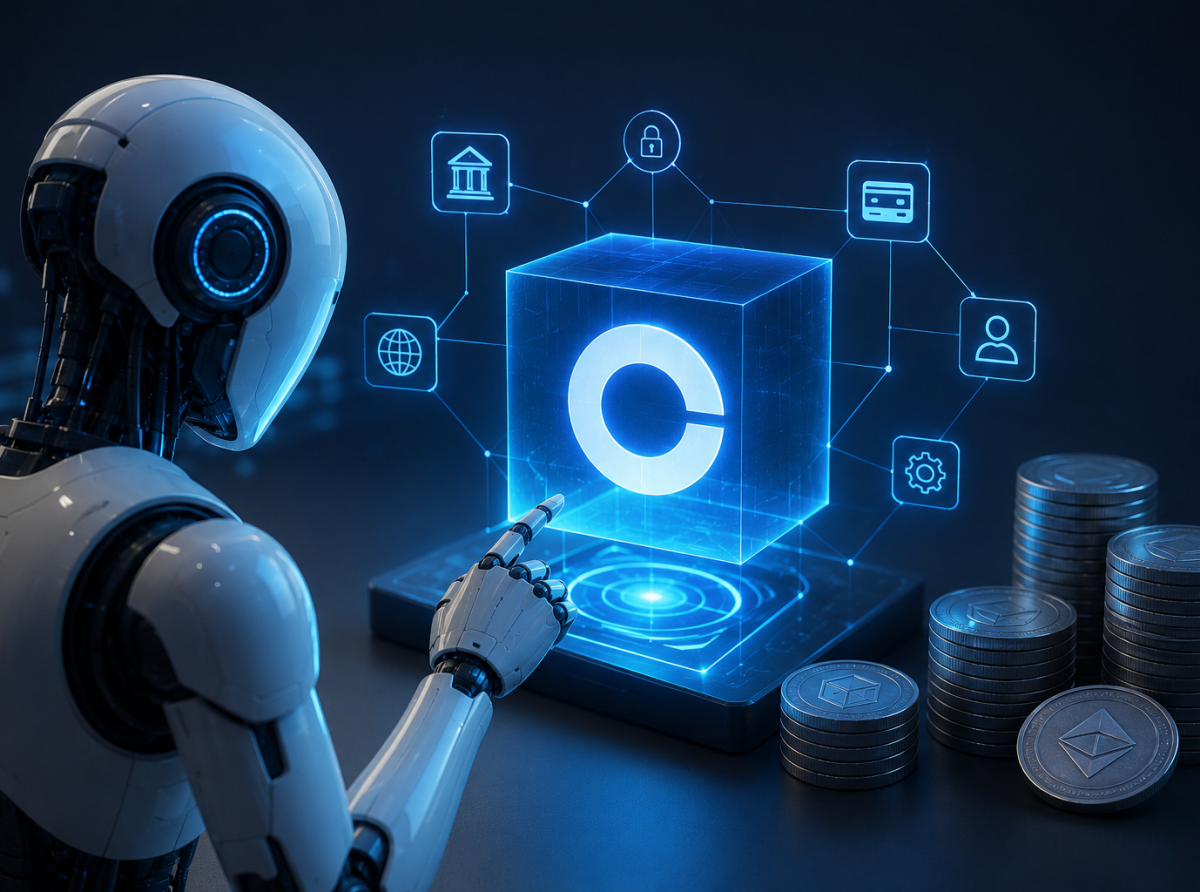
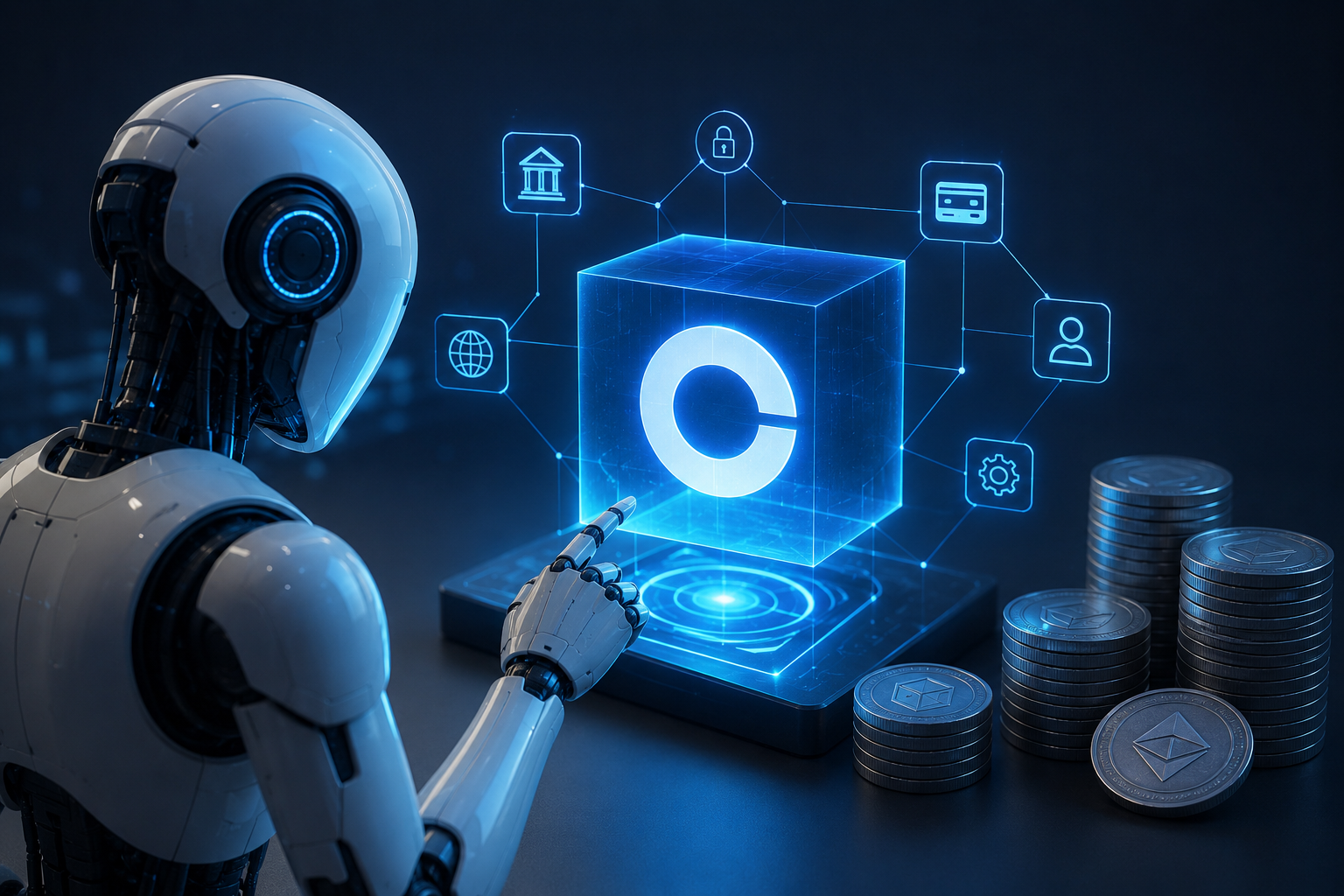
Coinbase is moving closer to a model in which artificial intelligence agents are not merely software tools operating on behalf of human users but autonomous economic participants capable of purchasing data, accessing digital services and interacting with financial markets.
Through Coinbase Business and the x402 payment protocol, companies can accept payments from AI agents using USDC, while developers can integrate machine-to-machine payments into APIs, web services and agent infrastructure.
The significance of this development lies less in the ability of a machine to send a stablecoin transaction than in the emergence of a new commercial architecture in which software can discover a service, evaluate its cost, pay for access and continue executing a task without a human being entering a card number, approving an invoice or maintaining a conventional subscription.
Coinbase is therefore attempting to solve one of the central problems of the emerging agent economy: AI systems may already be capable of making decisions and taking actions, but they have historically lacked a native financial layer through which those actions could acquire economic value.
Through Coinbase Business and the x402 payment protocol, companies can accept payments from AI agents using USDC, while developers can integrate machine-to-machine payments into APIs, web services and agent infrastructure.
The significance of this development lies less in the ability of a machine to send a stablecoin transaction than in the emergence of a new commercial architecture in which software can discover a service, evaluate its cost, pay for access and continue executing a task without a human being entering a card number, approving an invoice or maintaining a conventional subscription.
Coinbase is therefore attempting to solve one of the central problems of the emerging agent economy: AI systems may already be capable of making decisions and taking actions, but they have historically lacked a native financial layer through which those actions could acquire economic value.
The Internet Was Designed for Information, Not Autonomous Commerce
The modern internet is extraordinarily good at moving information. A software agent can request data from an API, retrieve a document, analyse a price feed or call another software service within milliseconds. The financial infrastructure supporting those interactions, however, was largely designed around human beings.Credit cards assume a cardholder. Bank accounts assume an account owner. Invoices assume a company with an accounts-payable department. Subscriptions assume a human or organisation willing to create an account, provide payment credentials and agree to a recurring charge.
AI agents do not naturally fit this model.
An autonomous agent may need to purchase a single piece of market data, access a specialised database for one query, pay for computing resources or obtain a digital service that it has never used before. A monthly subscription is often excessive for such a task, while a traditional payment process introduces a level of human intervention that undermines the very purpose of automation.
The economic problem is therefore relatively simple to describe. Software is becoming increasingly capable of acting independently, but the internet's payment infrastructure still assumes that a human must stand behind almost every transaction.
Coinbase's x402 is an attempt to close that gap.
The protocol uses the HTTP 402 “Payment Required” status code to allow a service to request payment directly within the normal web interaction. A service can indicate that a resource has a price, an agent can make a payment in USDC and the transaction can continue without the conventional sequence of account creation, login, card verification and invoice processing. Coinbase has described the system as a way to make stablecoin payments native to internet interactions and to allow APIs, applications and AI agents to transact programmatically.
The important change is not simply that a machine can hold a wallet.
It is that a machine can become a customer.
Coinbase Is Building a Financial System for AI Agents
Coinbase Wants to Make Agents Economically Useful
The latest expansion of Coinbase Business brings the payment side of this model closer to conventional companies. A business can provide goods or services online and accept USDC payments from an AI agent using the x402 infrastructure, while the agent can operate as the buyer without requiring a human to manually complete each payment.That creates a new relationship between software and commerce.
In the traditional internet economy, a human decides what to buy, enters a payment method and receives a service. In an agentic economy, the human may define an objective, while the agent decides which services are required to achieve it.
A user might instruct an agent to monitor a market, compare a set of financial instruments, collect data from several sources and execute a predefined strategy. The agent may then need to purchase real-time data from one provider, computational capacity from another and analytical services from a third.
Under the old internet economy, every one of these interactions could require separate accounts, API keys, subscriptions or human approval.
Under the emerging model, the agent could theoretically pay for each service when it is needed.
That is a profound change in the economics of software because it shifts the unit of commerce from the subscription to the action.
A company may no longer need to sell a user a monthly package of services if an agent can pay for individual requests. A data provider may charge per query. A computing platform may charge per task. A specialised AI model may charge per inference. A financial information service may charge for access to a particular dataset at the moment when an agent requires it.
The result is a more granular economy in which software services can be priced according to actual usage rather than bundled into products designed primarily around human purchasing habits.
The Payment Is Only One Part of the Agent Economy
It would be easy to assume that the development is mainly about cryptocurrency payments. That would underestimate its significance.The more important question is what happens when payment becomes a programmable component of an autonomous workflow.
An AI agent that can pay for a service is economically different from an AI agent that can only request free information. Once the agent has access to a controlled wallet and a defined spending authority, it can interact with a much larger part of the digital economy.
This does not mean that agents suddenly become independent economic entities in the legal or political sense. They remain software systems operating within technical and contractual frameworks established by people and companies.
But economically, the distinction between a user and a program begins to change.
A human may instruct the agent to achieve an objective. The agent may then decide which tools to use, compare available services and allocate a limited budget among them.
The crucial element is the budget.
Autonomous spending requires controls. An agent capable of paying for a service must also operate within limits governing the amount it can spend, the assets it can use, the services it can access and the conditions under which a transaction is permitted.
This is where the future of agentic commerce will be determined less by the ability to send a payment than by the quality of the controls surrounding that payment.
The question will not simply be whether an AI agent can spend money.
It will be whether people can trust it to spend the right amount of money, with the right counterparty, for the right purpose.
Why USDC Is Important to the Model
Coinbase's architecture is built around USDC, a dollar-pegged stablecoin that provides a relatively stable unit of account for digital transactions. That characteristic matters because autonomous software requires predictable pricing.An AI agent that pays for a service using a highly volatile asset faces an additional problem: the value of the payment can change substantially between the moment the transaction is authorised and the moment the service is delivered.
A dollar-denominated stablecoin reduces that uncertainty.
For a company selling digital services, the price can be expressed in a familiar unit. For an agent, the cost of a request can be calculated programmatically. For a developer building an autonomous application, the budget can be defined in terms that resemble conventional financial accounting.
This is one reason stablecoins have become increasingly relevant to the development of programmable payments. Their value is connected to traditional currency systems, while their settlement can take place through blockchain infrastructure.
The result is a hybrid model: a digital asset used to create a programmable payment mechanism with a unit of account familiar to businesses and consumers.
Coinbase Business says that USDC payments can settle into business accounts, with funds available in USDC and the option to convert them to fiat. Coinbase also describes x402 as a mechanism through which AI agents can pay businesses directly using stablecoins.
The Real Revolution May Be Pay-Per-Action Commerce
The traditional software industry has spent years moving toward subscriptions. The subscription model provided companies with recurring revenue and customers with continuous access to a product.The agent economy may push in the opposite direction.
An autonomous agent does not necessarily need a subscription to every service it can use. It may require a service only once, or it may use several competing providers depending on price, speed and quality.
This creates the possibility of a market in which software services compete dynamically for machine-generated demand.
An agent may request a particular dataset and compare several providers. It may choose the cheapest source that meets its quality requirements. If the price changes, the agent may switch providers. If the service becomes unavailable, the agent may find an alternative.
The transaction is no longer organised around the human relationship between a customer and a brand.
It is organised around a machine's ability to complete a task.
That could create significant pressure on existing business models. Companies that rely on customer loyalty, complicated subscription tiers or the friction involved in switching providers may find themselves operating in a market where software can compare alternatives far more quickly than humans.
At the same time, businesses may benefit from a much larger number of potential customers.
A small API provider that previously struggled to sell subscriptions to individual users could potentially monetise every automated request made by an agent.
The commercial value of a service would therefore depend not only on how many humans use it but on how many autonomous systems require it.
The Financial Market Is a Natural Laboratory for Agentic Commerce
Financial markets are particularly well suited to this model because they already operate through data, automation and continuous decision-making.A market agent can monitor prices, analyse economic information, evaluate predefined conditions and execute transactions. The next step is to give such systems greater autonomy in obtaining the information and services they require.
Coinbase has also been expanding the ability of users to interact with trading activity through natural-language instructions, while providing real-time visibility into orders and market data. The company has described a model in which users can express trading conditions in ordinary language and agents can monitor markets and execute predefined actions.
The potential implications are significant.
A trading agent could pay for a specialised data feed only when a particular market condition emerges. It could obtain additional computational capacity during periods of high volatility. It could purchase a research service to evaluate a specific event. It could then use the result to determine whether the conditions for a trade have been met.
The traditional model would require a human to subscribe to every tool in advance.
The agent model allows services to be acquired when they become economically useful.
This could reduce the cost of experimentation and increase the number of tools available to smaller market participants.
It could also increase the speed at which market strategies evolve.
The Role of Brokers Could Change
The development of AI-agent payments has implications for financial intermediaries, including brokers.At present, a retail trader generally interacts with a broker through a human-controlled interface. The trader opens an account, deposits funds, studies the market and manually or semi-automatically places orders.
The growing autonomy of AI agents could change the structure of this relationship.
An agent may eventually monitor multiple markets, access paid data sources, compare liquidity conditions and interact with trading infrastructure on behalf of a user. The broker may increasingly become not only a platform for human traders but also an execution and financial infrastructure layer for autonomous software.
This would create new opportunities but also new risks.
A broker serving AI agents would need to understand not only the identity of the human account holder but also the permissions granted to the software operating on that account. The question of whether an agent can trade is relatively simple. The more difficult question is what exactly the agent is authorised to do.
Can it open a position?
Can it change the risk parameters?
Can it transfer funds?
Can it pay an external data provider?
Can it continue operating after the user has gone offline?
The financial system has already developed rules around human authorisation and account access. Agentic commerce introduces a new layer in which the software itself becomes an active participant in the transaction.
For brokers, this could eventually create demand for programmable permissions, spending limits, transaction policies and machine-readable risk controls.
The broker of the future may need to understand not only the trader's strategy but also the behaviour of the software executing it.
The New Infrastructure Race Is Not About AI Alone
The emerging agent economy is often described as a competition between AI models. That is only part of the story.An autonomous agent requires several layers of infrastructure.
It needs a model capable of reasoning. It needs access to data. It needs tools through which it can interact with external systems. It needs a wallet or payment mechanism. It needs identity and permission controls. It needs an execution environment. It needs monitoring.
The failure of any one of these components can disrupt the entire system.
An intelligent agent without access to reliable data is limited. An agent with data but no ability to pay for services is constrained. An agent with a wallet but inadequate controls creates a financial risk.
This means that the competitive advantage may increasingly belong to companies capable of integrating the entire stack.
Coinbase is attempting to occupy several layers simultaneously: digital asset infrastructure, stablecoin payments, developer tools, business settlement and agentic commerce.
The strategy is clear. If AI agents become economically active, the company that provides the wallet, the payment rail and the settlement infrastructure may become an important part of the digital economy that those agents create.
The Biggest Challenge Is Trust
The vision of autonomous payments is attractive because it removes friction. But friction sometimes exists for a reason.Human payment systems contain multiple layers of confirmation, identity verification and institutional control. An autonomous agent can operate faster precisely because many of those steps are automated or removed.
That creates a difficult balance. The more freedom an agent receives, the more useful it becomes. The more freedom it receives, the greater the potential consequences of an error.
An agent that accidentally purchases one unnecessary API call creates a minor problem. An agent that repeatedly spends funds on an inappropriate service can create a much larger one. An agent that is manipulated by false information or compromised instructions may make transactions that are technically authorised but economically harmful.
This is why the future of autonomous payments will depend heavily on permission architecture.
The most important question may be not whether an agent has access to a wallet but what the wallet is allowed to do.
A controlled wallet with limited spending authority is fundamentally different from an unrestricted account.
This principle is particularly important in financial markets, where a software error can produce losses far more quickly than a human operator can intervene.
Security Will Become an Economic Problem
The security challenges of agentic commerce are not limited to traditional cybersecurity.A conventional cyberattack may attempt to steal credentials or disrupt a system. An attack on an autonomous economic agent may attempt to influence the agent's decisions.
The attacker may not need to steal the wallet directly. It may be enough to manipulate the information the agent receives, the service it selects or the instructions it follows.
This creates a new category of risk in which the security of data, instructions and payments becomes interconnected.
The agent may have valid authorisation and still make an economically harmful decision because the information guiding that decision was manipulated.
The financial consequences could be significant.
An agent that automatically pays for data, services and transactions creates a new target for attacks designed not simply to access funds but to redirect spending.
For the ecosystem to scale, payment infrastructure will therefore need to be accompanied by strong monitoring, transaction policies and mechanisms capable of detecting unusual behaviour.
The machine economy will require something similar to financial risk management, but adapted to software that can make decisions at machine speed.
Coinbase Is Betting That Payments Will Become Invisible
The long-term ambition behind x402 is not necessarily to make users think about blockchain transactions more often. It may be the opposite.The most successful payment infrastructure is often the infrastructure that users barely notice. A consumer does not want to think about the technical details of every card transaction. A company does not want to manually process every small payment made by an autonomous software system.
Coinbase's strategy is to make the payment layer increasingly invisible while making the economic interaction itself more programmable.
The agent requests a service.
The service identifies a price.
The agent pays.
The service responds.
The process resembles a normal internet request, except that the request carries an economic transaction.
That is the central idea behind x402.
The blockchain is not necessarily presented as the product.
It becomes the settlement layer beneath the product.
The New Customer May Not Be Human
The most important consequence of agentic payments may be conceptual.For decades, businesses designed products around human customers. Websites were built for human attention. Payment systems were built for human approval. Subscription models were built around human consumption.
The agent economy introduces another category of customer.
A software agent may have no personal preferences, no brand loyalty and no interest in marketing. It may care only about whether a service meets a defined requirement at an acceptable price.
That creates a market in which companies will increasingly need to make their services discoverable, machine-readable and economically accessible to autonomous systems.
The business that cannot explain its price, service quality and payment requirements to an agent may become invisible to the next generation of customers.
This could transform digital marketing as well.
Search engine optimisation was designed to help websites become visible to humans and search engines.
The next stage may involve making services understandable to autonomous agents that can independently evaluate, purchase and use them.
The commercial competition may therefore shift from attracting attention to becoming a reliable component in an agent's decision-making process.
The Financial System Is Moving Towards Machine-to-Machine Commerce
Coinbase's expansion of x402 is part of a broader movement toward machine-to-machine commerce.The underlying logic is straightforward. If AI agents are expected to operate independently, they need access not only to information but also to economic resources.
They need to pay for the services they use.
They need to receive revenue for the services they provide.
They need to operate within budgets.
They need to interact with other agents.
And they need to do this without requiring a human to approve every individual transaction.
Stablecoins and blockchain networks provide a potential infrastructure for this model because they can support programmable payments and global settlement.
But technology alone will not determine whether the model succeeds.
The critical issues will involve trust, security, compliance, identity, permission management and the ability to connect autonomous systems to existing businesses.
Coinbase is attempting to position itself at the centre of this transition by connecting the payment needs of AI agents with the commercial infrastructure of companies.
The opportunity is substantial. So are the risks.
The Next Financial Customer May Be an Algorithm
The development of AI-agent payments represents a shift from software as a tool to software as an economic actor.That transition will not happen overnight, and the technology is still developing. But the direction is becoming increasingly visible.
AI agents are gaining the ability to analyse information, use tools, interact with APIs and perform complex tasks. The missing element has often been the ability to transact economically with the services required to complete those tasks.
Coinbase is attempting to provide that missing layer.
The importance of x402 therefore extends beyond cryptocurrency payments. It reflects a broader attempt to redesign the relationship between software and commerce.
In the traditional economy, a person decides, a company provides and a payment system settles the transaction.
In the emerging agent economy, software may decide, software may provide and software may settle the transaction.
Humans will still define objectives, allocate capital and establish the rules.
But the individual economic actions may increasingly be performed by machines.
That is the point at which artificial intelligence stops being merely a technology used by the economy.
It becomes one of the participants in the economy.
And once software can pay for what it needs, the market for autonomous agents becomes considerably larger than the market for AI assistants.
It becomes a market for customers that never sleep, never fill in a checkout form and may choose a service entirely according to price, quality and availability.
The financial infrastructure built for that market is only beginning to emerge.
By Jake Sullivan
July 24, 2026
Join us. Our Telegram: @forexturnkey
All to the point, no ads. A channel that doesn't tire you out, but pumps you up.
July 24, 2026
Join us. Our Telegram: @forexturnkey
All to the point, no ads. A channel that doesn't tire you out, but pumps you up.




Report
My comments