




US Chipmakers Dominate AI and Processors: Growth Outlook to 2032
US Chipmakers Dominate AI and Processors: Growth Outlook to 2032
In 2026, US chipmakers dominate ключевые сегменты — AI accelerators, CPUs and advanced memory — with companies like NVIDIA and Intel driving innovation and revenue growth.
According to recent policy and industry data (April 2026, U.S. Department of Commerce), the CHIPS and Science Act allocates $52 billion in subsidies to expand domestic semiconductor manufacturing.
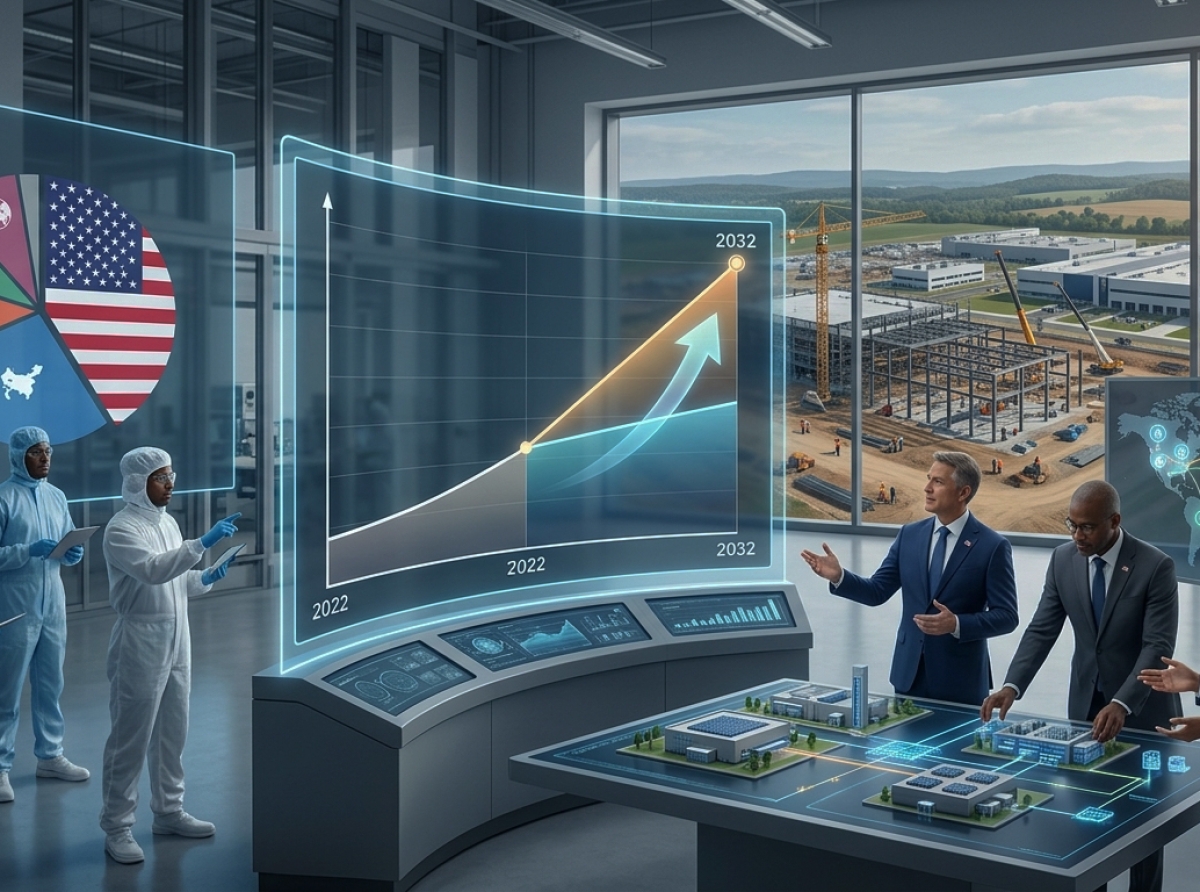
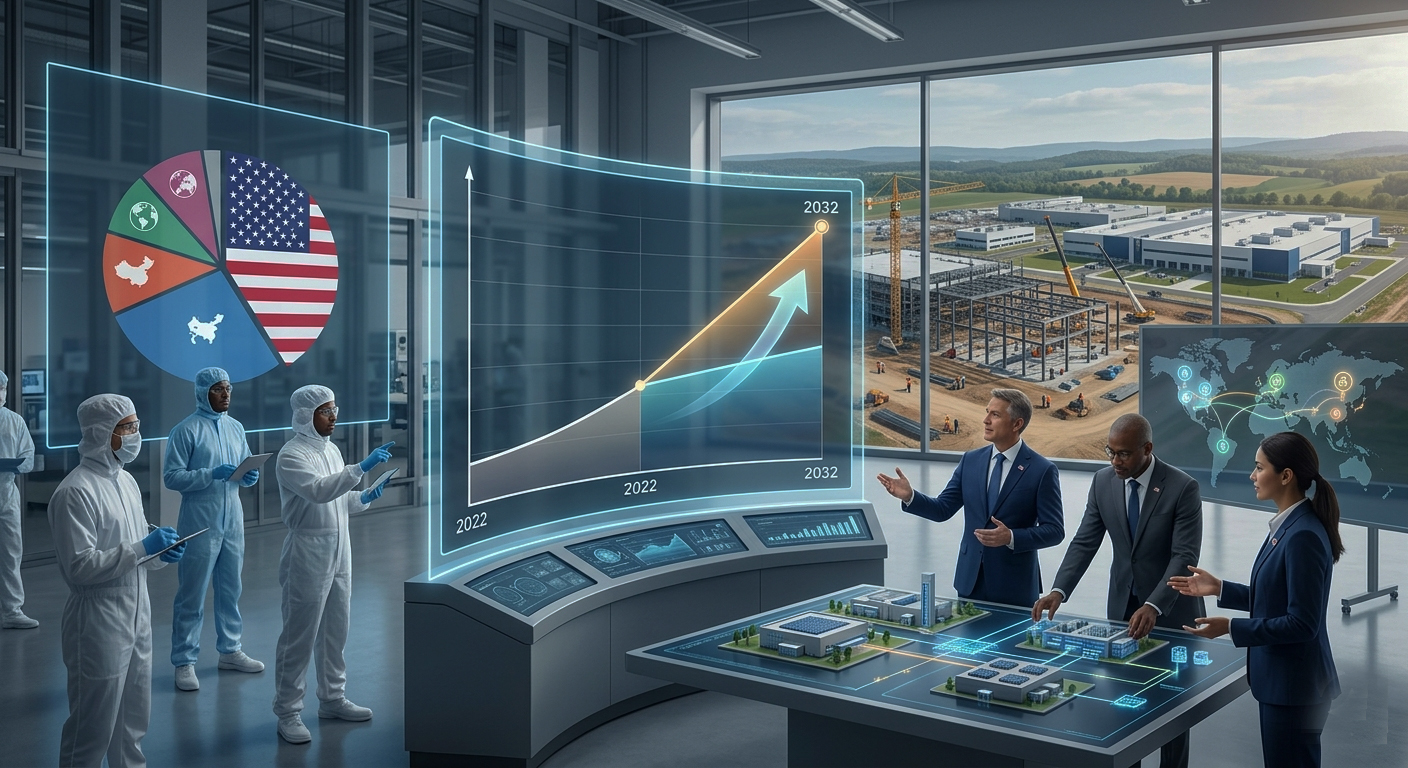
As a result, US chip production is projected to triple by 2032, increasing global market share to ~14%. New product cycles, including Intel Panther Lake and Qualcomm Snapdragon Elite X2, further reinforce US leadership in high-performance computing.
According to recent policy and industry data (April 2026, U.S. Department of Commerce), the CHIPS and Science Act allocates $52 billion in subsidies to expand domestic semiconductor manufacturing.
As a result, US chip production is projected to triple by 2032, increasing global market share to ~14%. New product cycles, including Intel Panther Lake and Qualcomm Snapdragon Elite X2, further reinforce US leadership in high-performance computing.
Why US chipmakers lead in AI, CPUs and memory in 2026
The competitive advantage of US semiconductor firms is built on three pillars: architecture leadership, ecosystem control and capital intensity. NVIDIA dominates AI accelerators through its CUDA ecosystem, while Intel continues to expand in CPUs and foundry services.Structured snapshot (April 2026):
| Segment | Leader | Key Strength |
|---|---|---|
| AI accelerators | NVIDIA | GPU + software ecosystem |
| CPUs | Intel | x86 dominance + roadmap |
| Mobile/ARM chips | Qualcomm | Energy-efficient design |
| Foundry (US) | Intel / GlobalFoundries | Domestic production |
This structure reflects a broader shift: hardware is no longer standalone — it is tied to software ecosystems and AI workloads.
From a market desk: demand for AI chips surged following enterprise adoption of generative AI models in Q1 2026, pushing semiconductor indices higher despite macro uncertainty.
US Chipmakers Dominate AI and Processors: Growth Outlook to 2032
Growth drivers: CHIPS Act and industrial policy
The CHIPS and Science Act represents the most significant industrial policy shift in US semiconductor history.With $52 billion in subsidies, the program targets:
Expansion of domestic fabrication capacity
Reduction of reliance on Asian supply chains
Acceleration of R&D in advanced nodes
According to official projections (U.S. Department of Commerce, April 2026), US manufacturing output is expected to triple by 2032.
Micro-case: a new fabrication facility supported by federal incentives reduced supply chain lead times for domestic clients by up to 30%, improving resilience during demand spikes.
Product cycle 2026: new platforms reshape competition
Two major announcements define the 2026 cycle:Intel Panther Lake — next-generation CPU architecture focused on AI integration
Qualcomm Snapdragon Elite X2 — ARM-based platform targeting laptops
These launches highlight a critical trend: convergence between traditional computing and AI workloads.
Analytical insight: in practice, the competition is shifting from raw performance to efficiency per watt and AI-specific optimization.
Competition: US vs China semiconductor race
Despite aggressive investment by China, the US maintains a technological edge.Structured comparison (2014–2023 cumulative subsidies):
| Region | Investment | Focus |
|---|---|---|
| China | $142B | Capacity expansion |
| USA | $39B (pre-CHIPS) | Innovation + design |
Even though China’s subsidies are approximately 3.6 times larger, US firms lead in advanced node design and AI chip architecture.
| Company | Revenue (USD bn) | Specialization | Headquarters |
|---|---|---|---|
| NVIDIA | 130.5 | GPUs, AI | Santa Clara, CA, USA |
| Intel | 53.1 | CPUs | Santa Clara, CA, USA |
| Broadcom | 51.6 | Networking, wireless chips | Palo Alto, CA, USA |
| Qualcomm | 40.7 | Mobile chips, 5G | San Diego, CA, USA |
| Micron | 25.1 | Memory (DRAM, NAND) | Boise, ID, USA |
From a geopolitical desk: export controls and technology restrictions continue to shape global supply chains, reinforcing regional fragmentation.
Localization trend: reducing dependence on Asia
US companies are actively reshoring production:Intel expanding domestic fabs
GlobalFoundries scaling US-based production
SkyWater Technology focusing on secure, government-linked manufacturing
This shift aims to mitigate risks associated with geopolitical tensions in Asia, particularly around Taiwan.
Micro-story: a US-based industrial client shifted sourcing from Asia to domestic fabs after supply disruptions in 2025, accepting higher costs in exchange for reliability.
Market implications for investors and traders
Semiconductors are now a core macro theme:Equities: AI-driven chip demand supports valuations
Forex: USD benefits from capital inflows into US tech
Commodities: semiconductor production increases demand for rare materials
According to market data (April 2026, Yahoo Finance), semiconductor stocks have shown strong correlation with AI adoption trends, outperforming broader tech indices.
The outlook suggests sustained growth driven by:
AI infrastructure expansion
Government subsidies
Supply chain localization
Forward projection: by 2032, US chipmakers will increase global share to ~14%, with AI chips representing the fastest-growing segment.
Analytical conclusion: the semiconductor industry is transitioning from cyclical to structurally growth-driven, with AI as the primary catalyst.
US chipmakers are not just leading — they are reshaping the global semiconductor landscape. With strong policy support, rapid innovation and AI-driven demand, the sector is entering a new growth phase that will define technology markets for the next decade.
By Claire Whitmore
April 23, 2026
Join us. Our Telegram: @forexturnkey
All to the point, no ads. A channel that doesn't tire you out, but pumps you up.
April 23, 2026
Join us. Our Telegram: @forexturnkey
All to the point, no ads. A channel that doesn't tire you out, but pumps you up.





Report
My comments