

Custodial vs Non-Custodial Wallets: What’s the Difference?
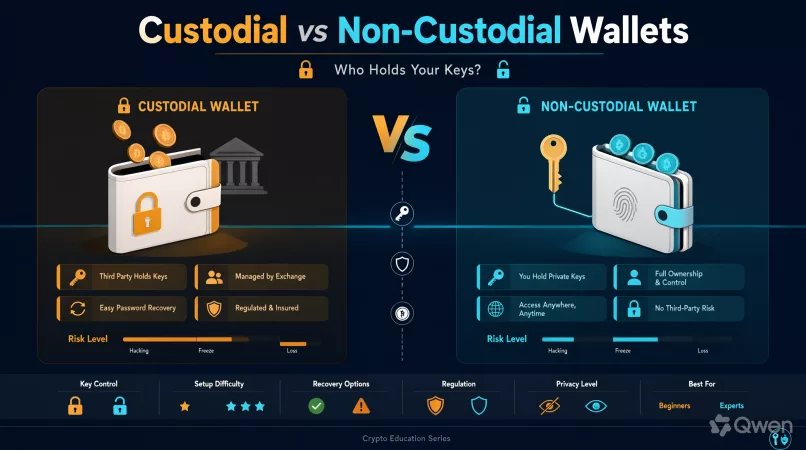
Custodial vs non-custodial wallets differ mainly in who controls the private keys used to access and transfer cryptocurrency. A custodial wallet is managed by a third party, usually a crypto exchange or wallet provider. It offers convenient account access, customer support, and potential recovery options, but users depend on the provider to safeguard their assets and process withdrawals. A non-custodial wallet gives users direct control of their keys. This removes reliance on a custodian, but also makes users responsible for backups, device security, and transaction approvals. Neither model is automatically safer in every situation. The right choice depends on how much control a person wants, how confidently they can manage security, and what they plan to do with their crypto. MPC and smart contract wallets add further options between traditional custody models.
What Is a Crypto Wallet?
A crypto wallet does not physically store coins or tokens. Cryptocurrency remains recorded on its blockchain. The wallet manages the cryptographic keys that allow a user to access assets associated with an address and authorize transactions.
A private key is a secret credential used to produce a valid digital signature. The network checks that signature when a transaction is submitted. In practical terms, control of the relevant private key determines who can authorize transfers from an account. On Ethereum, for example, an externally owned account is controlled by a public-private key pair, while a contract account follows rules written into a smart contract.
This distinction explains the difference between custodial and non-custodial wallets. In the first model, a service provider controls the keys on the customer’s behalf. In the second, the user controls the keys directly. That choice affects more than the interface: it determines who is responsible for security, how access can be restored, and which party the user must trust.
What Are Custodial Wallets?
A custodial wallet is a service in which a third party holds and manages the private keys associated with customer assets. The provider is commonly a centralized cryptocurrency exchange, although dedicated custody services also exist.
Users generally access their balances through an account, using a password, authentication app, or other login method. They can deposit, trade, or withdraw crypto without having to manage private keys themselves. The provider handles key storage and transaction signing within its own systems.
What users gain
- Convenience: no need to create, store, and protect a recovery phrase personally.
- Account recovery: a provider may restore access after identity checks or other verification.
- Integrated services: trading, deposits, withdrawals, staking, and reporting may be available in one account.
- Customer support: users can contact the provider if they have login or account problems.
What users give up
- Direct control: the provider, not the customer, controls the keys.
- Counterparty exposure: access to funds depends on the provider’s security, financial condition, and operating policies.
- Reduced privacy: custodial services commonly require identity verification and may monitor transactions to meet legal and compliance obligations.
- Withdrawal restrictions: the provider may suspend or limit account activity under its terms or applicable legal requirements.
The main risk is counterparty risk. Customers rely on the custodian to protect the keys and honor valid withdrawal requests. A security breach, operational failure, insolvency, or account restriction can affect access to funds. Even if the blockchain itself continues operating normally, customers may be unable to move assets while a provider investigates an incident or resolves financial and legal problems.
Custodial wallets can therefore be practical for beginners and active traders who value a familiar account experience. However, choosing a well-known exchange does not eliminate the need to assess its custody arrangements, withdrawal rules, security practices, and financial disclosures. A company account balance is not the same as having direct control of the underlying private keys.
What Are Non-Custodial Wallets?
A non-custodial wallet, also called a self-custody wallet, gives the user control of the private keys. These wallets are available as mobile apps, browser extensions, desktop software, and dedicated hardware devices. During setup, many generate a recovery phrase that can be used to restore access if the original device is lost or replaced.
Because the user controls the keys, a wallet provider generally cannot independently authorize a transaction or freeze the user’s key-controlled account. The user can interact directly with blockchain applications, decentralized exchanges, and smart contracts without asking a centralized exchange to process each action.
What users gain
- Direct control: the user decides when and where to authorize transactions.
- Reduced custodian dependence: access does not rely on an exchange remaining solvent or continuing to provide its wallet service.
- Access to decentralized applications: users can connect to DeFi protocols, NFT platforms, and other blockchain services.
- Potentially greater privacy: creating a wallet often does not require identity verification, although blockchain activity is public and other services may collect personal information.
What users take on
- Key security: the user must protect private keys and recovery information from theft, loss, and unauthorized disclosure.
- Backup responsibility: losing a device is manageable only if the wallet can be restored using a valid backup or another recovery method.
- Irreversible mistakes: blockchain transactions are generally difficult or impossible to reverse once confirmed.
- Technical responsibility: users must check addresses, networks, transaction details, and smart contract permissions before signing.
The most serious self-custody risk is losing access to the keys and having no working recovery method. If a recovery phrase is lost and the wallet has no alternative recovery mechanism, the assets may become permanently inaccessible. If someone else obtains the phrase or private key, that person may be able to transfer the funds. A wallet provider or customer support team cannot simply reset the blockchain credentials as if they were an ordinary website password.
It is also important not to confuse control of a wallet with unlimited control over every asset. A self-custody wallet provider may not be able to freeze a user’s keys, but particular tokens or smart contracts can have their own transfer restrictions or administrative controls. Self-custody reduces dependence on a custodian; it does not remove every risk associated with a blockchain asset.
How Do Custodial and Non-Custodial Wallets Compare?
The practical differences become clearer when the two models are compared across key areas.
|
Feature |
Custodial wallet |
Non-custodial wallet |
| Who controls the private keys? | The provider | The user |
| Who authorizes transactions? | The provider’s systems, following user instructions and platform rules | The user, through the wallet’s signing mechanism |
| Access recovery | May be available through the provider’s verification process | Depends on the wallet’s backup or recovery design |
| Can the provider restrict access? | Yes, subject to its terms and applicable requirements | A wallet provider generally cannot independently control user-held keys |
| Counterparty risk | Depends on the custodian’s security and financial condition | No exchange custodian is required to control the keys |
| Privacy | Usually involves account registration and identity checks | Wallet creation may not require ID, but blockchain activity is public |
| Typical use | Exchange trading and convenient account-based access | Direct asset control and interaction with decentralized applications |
Neither column represents a universal security ranking. Custodial services concentrate key management in an organization that may have professional security systems, but users must trust that organization. Self-custody removes that particular dependency, while exposing users to risks such as phishing, malware, insecure backups, and mistakes when signing transactions.
MPC, Multisig, and Smart Contract Wallets
Newer wallet designs can make the distinction less binary.
MPC wallets use multi-party computation to distribute key-related material among separate devices or participants. In a threshold signature scheme, a required number of participants cooperate to produce a valid signature without necessarily reconstructing the complete private key in one place. For example, a 2-of-3 arrangement requires two of three designated shares to participate. This can reduce dependence on a single device or credential.
However, MPC does not automatically mean non-custodial. The actual custody model depends on who controls the shares, who can initiate or approve signing, and whether the provider can act without the user’s participation. Users should examine the provider’s recovery process and key-share architecture rather than relying on the MPC label alone.
Multisignature wallets require more than one separate key to approve a transaction. A configuration such as 2-of-3 can allow a transaction to proceed when any two of three authorized signers approve it. This can protect against the loss or compromise of a single key, but it also introduces coordination and backup requirements.
Smart contract wallets use programmable blockchain accounts rather than relying exclusively on a conventional externally owned account. On Ethereum, account abstraction standards such as ERC-4337 support smart accounts with customizable validation and transaction logic. Depending on implementation, features can include spending limits, multiple approval requirements, sponsored transaction fees, and social recovery.
Social recovery allows designated trusted contacts or guardians to help restore control under predefined rules. It does not mean that a wallet provider can automatically retrieve every lost account. The recovery mechanism must have been configured, and its security depends on the chosen guardians, thresholds, and smart contract implementation.
These designs can improve usability and resilience, but they introduce their own technical and operational risks. Smart contract vulnerabilities, poorly configured recovery rules, compromised participants, or a provider’s control over key shares can undermine the intended protection.
Which Wallet Should You Use?
The choice depends on your experience, transaction habits, and ability to manage security.
A custodial wallet may be a reasonable starting point for someone who is new to crypto, trades frequently, or prefers account recovery and customer support. It reduces the need to manage private keys directly, but it does not remove the risk of exchange failure, withdrawal restrictions, or account compromise. Before depositing funds, review the provider’s custody arrangements, security controls, withdrawal policy, and applicable terms.
A non-custodial wallet may be more suitable for users who want direct control, regularly use decentralized applications, or plan to hold crypto without relying on an exchange. For larger long-term holdings, a hardware wallet can reduce exposure of private keys to internet-connected devices. It does not eliminate risks such as physical loss, compromised recovery information, malicious transaction approvals, or user error.
Some users combine both approaches: keeping a limited trading balance with an exchange and holding longer-term assets in a self-custody wallet. This can separate day-to-day activity from savings, although it requires users to manage two different security models.
Whichever model you choose, follow a few basic practices:
- Use a unique, strong password for custodial accounts and enable two-factor authentication.
- Never share a private key or recovery phrase with anyone, including people claiming to represent wallet support.
- Keep recovery information offline and in a secure location. Avoid screenshots or unencrypted cloud backups.
- Check the recipient address, blockchain network, and transaction details before signing.
- Be cautious with wallet connections and token approvals. A legitimate-looking application can still request dangerous permissions.
- Test the recovery process and understand what happens if a device, key share, or trusted guardian becomes unavailable.
Frequently Asked Questions
What is the main difference between custodial and non-custodial wallets?
The main difference is who controls the private keys. A custodial provider holds and manages the keys for the user. A non-custodial wallet gives the user direct control, along with responsibility for protecting access.
Can a custodial wallet freeze my crypto?
A custodial provider can restrict access to an account or suspend withdrawals under its terms, compliance procedures, or applicable legal requirements. The user depends on the provider to authorize transactions from the custodied wallet.
Can anyone freeze funds in a non-custodial wallet?
A wallet provider generally cannot independently freeze an account if the user alone controls the private keys. However, some tokens and smart contracts have built-in administrative controls or transfer restrictions. The absence of a custodian does not guarantee that every asset can always be transferred.
What happens if I lose my non-custodial wallet?
If you lose the device but have a valid recovery phrase or another supported backup, you can usually restore the wallet on a replacement device. If all recovery methods are lost, access may be permanently unavailable. The exact process depends on the wallet’s design.
Are non-custodial wallets safer than custodial wallets?
Not automatically. Self-custody removes the risk of depending on an exchange to safeguard and release your keys, but it makes the user responsible for security and recovery. Custodial wallets may offer professional key management and account support, but they introduce counterparty risk. The safer choice depends on which risks the user can manage more effectively.
What is the difference between MPC and multisig wallets?
MPC wallets use a cryptographic protocol in which multiple participants or devices cooperate to create a signature using distributed key material. Multisig wallets use multiple distinct keys and require a specified number of signatures to approve a transaction. Both can distribute control, but they work differently and have different technical requirements.
Closing Thoughts
Custodial and non-custodial wallets offer different ways to manage access to cryptocurrency. Custody prioritizes convenience and provider-assisted recovery, while self-custody prioritizes direct control and independence from an exchange. Neither option removes risk; it changes where that risk sits and who is responsible for managing it.
MPC, multisig, and smart contract wallets add more flexible security and recovery arrangements, but their labels alone do not guarantee protection. Before choosing a wallet, find out who controls the keys, who can approve transactions, and what happens if access is lost. Understanding those three points is the foundation of responsible crypto custody.
By Claire Whitmore