

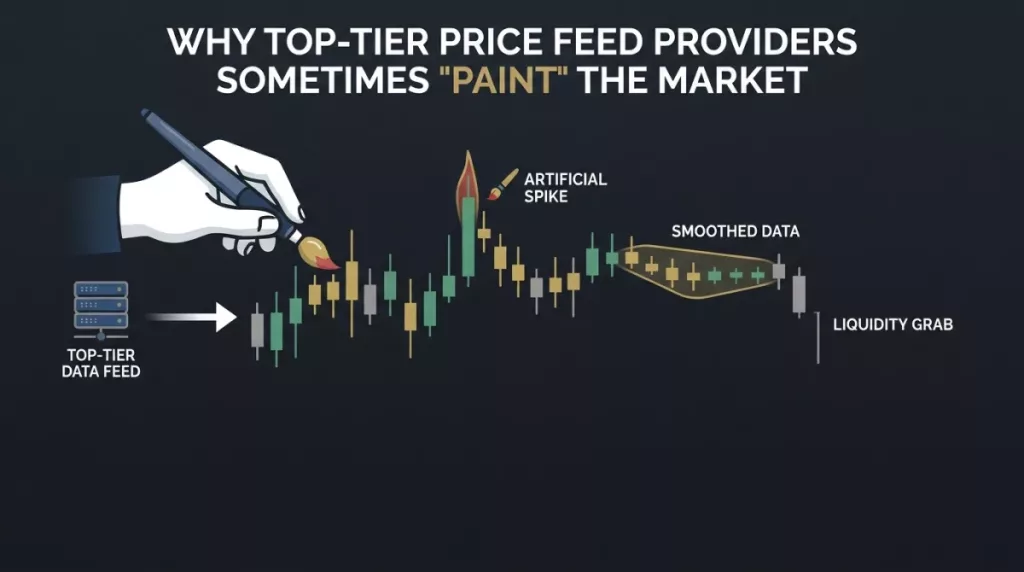
Why Even Top-Tier Price Feed Providers Sometimes “Paint” the Market
Why do quotes from different providers fail to match?
Price Feed Providers can display different values for the same currency pair without any party necessarily manipulating the market. The global Forex market has no single central order book or mandatory universal price. Providers receive data from different banks, electronic venues, brokers and non-bank liquidity providers. They apply different aggregation, filtering and update methodologies, and may distribute both executable and indicative quotes. During volatile periods, discrepancies can widen as latency increases, spreads expand, liquidity is withdrawn and execution controls become more restrictive.
For a broker, this is not simply a chart-display issue. A misunderstood or poorly controlled price stream can lead to disputed fills, requotes, adverse P&L effects, client complaints, additional dealing-desk workload and regulatory exposure. The objective is not to find one supposedly “perfect” price. It is to demonstrate control over data quality and fair execution across the entire pricing and order lifecycle.
1. Forex Is Not a Single Exchange Tape: Where Different Prices Come From
On a centralized exchange, participants can observe the order book of that particular venue. Spot Forex is different: it is predominantly an over-the-counter (OTC) market. Transactions take place through dealer banks, electronic venues, single-dealer platforms, brokers and non-bank liquidity providers. Participants may have different counterparties, credit limits, available liquidity and execution terms. One liquidity provider’s EUR/USD quote therefore does not have to match another provider’s quote at precisely the same millisecond.
The Bank for International Settlements (BIS), in its analysis based on the 2025 Triennial Survey, describes FX execution as decentralized and fragmented. Trading takes place across multiple venues and directly between customers and dealers. The BIS reports that dealers internalise more than 80% of customer trades within their own liquidity pools. In April 2025, electronic trading accounted for 59% of activity, while voice execution remained relevant, particularly for large spot trades and bespoke derivatives. “The market price” is better understood as a range of prices available under different conditions — including size, counterparty, time and execution terms.
It is essential to distinguish among a market-data feed, an indicative quote, an executable quote and a fill price. A data feed is the technical delivery of pricing information. An indicative quote is a reference level. An executable quote is a price at which a provider is prepared to accept a trade request under specified conditions. A fill price is the actual execution price. Treating these as interchangeable is a methodological mistake: an indicative mid-price is not a promise to execute a client order at that level.
2. Seven Reasons Why Providers Display Different Quotes
Different source pools and aggregation methodologies
One provider may build its stream from quotes supplied by several banks; another may rely on electronic venues and firm orders; a third may include last-look streams or contributor quotes. Even where source pools overlap, providers can differ in source weighting, outlier filters, mid-price calculations, update frequency and the way they handle missing data. Bloomberg’s BFIX methodology describes an input-data hierarchy that prioritises executed prices, then executable prices, and then indicative prices. A large number of sources does not automatically produce an identical result: the selection methodology matters.
Indicative prices presented as if they were executable
An indicative quote can help market participants assess prevailing levels, but it may not represent a firm offer. It can reflect the latest price received from a contributor even after the underlying liquidity has changed or disappeared. LSEG’s technical comparison distinguishes contributor-based indicative quotes from data derived from firm orders or venue activity. In the specific feeds and periods examined, its analysis found that the indicative Super RIC could lag other streams and retain a stale spread during sharp market moves. This provider-specific study is not evidence that all indicative feeds behave in the same way.
Data-transmission latency and stale ticks
Even when a source updates its price in real time, information passes through networks, gateways, normalization layers, an aggregator, a bridge, the broker’s server and the trading platform. Delay can occur at any point. LSEG reported that, in the data it examined, some contributor quotes were already hundreds of milliseconds old by the time they reached aggregation. In the studied examples, reaction-time differences around market events reached several seconds. Such delays may be difficult to notice in quiet markets, but fractions of a second can matter during a major data release.
Different market depth and trade sizes
The best price visible on screen may be available only for a small amount. If a broker requests a larger size, the price may move along the liquidity ladder (market impact); part of the order may fill at the next available level, while the remainder may be rejected. A quote for 100,000 units of the base currency is not necessarily comparable with a quote for 5 million units. Comparisons are meaningful only when size and execution conditions are comparable.
Different trading hours, liquidity conditions and credit constraints
Liquidity is unevenly distributed across trading sessions and currency pairs. For exotic pairs, local holidays, the weekly market open and major news events, sources may update less frequently or widen spreads. Interbank credit limits also affect which counterparties can quote to one another and on what terms. LSEG’s 2023 research noted that credit constraints in certain currencies can contribute to delays in price formation.
Last look and pre-trade price validation
Last look is a mechanism under which a liquidity provider has a short window, after receiving a trade request, to validate the price and decide whether to accept or reject the trade. It can affect the difference between the quote displayed on screen and the final execution outcome, but it does not, by itself, mean that a chart is being manipulated. The FX Global Code, updated in December 2024, says market participants using last look should be transparent and provide appropriate client disclosures. These should explain whether and how price changes in either direction affect acceptance or rejection, the expected or typical decision window, and the purpose of last look. The Code also calls for governance and controls consistent with disclosed terms.
Data, configuration and technology errors
An incorrect instrument symbol, misplaced decimal precision, wrong conversion factor, invalid timestamp, duplicate tick, packet loss, clock-synchronisation problem or failover error can create an outlier, freeze a quote or produce an incorrect bid/ask. Sometimes the source is correct and the distortion appears inside the broker’s middleware: a bridge applies the wrong markup, an aggregator selects an outdated source, or the platform displays a different level of precision. These are control issues for the broker and its technology vendors.
3. When Is a Quote Difference Normal Market Microstructure — and When Is It a Warning Sign?
A difference of a few points is not automatically an error. The context matters: do timestamps, price types, trade sizes, bid/ask sides, trading sessions, sources and execution conditions match? If two providers publish different mid-prices but both streams are indicative and use different contributors, the difference may be a normal consequence of their methodologies. A stream that has stopped updating, shows a one-sided market, moves sharply outside the range of independent sources or continues publishing a price after liquidity has disappeared deserves investigation.
- Expected market difference: different sources, spreads, sizes and quote types; the discrepancy can be explained by prevailing market conditions.
- Technical anomaly: stale quote, timestamp drift, missing ticks, incorrect precision, duplication or a price jump unsupported by other sources.
- Execution discrepancy: the displayed price differed from the price available when the order arrived; possible causes include latency, market impact, last look or a change in liquidity.
- Potential misconduct: persistent asymmetry, unexplained deviations that consistently disadvantage the client, selective changes to historical data or a missing audit trail.
The last category requires particular care. A screenshot or comparison with a public chart is not enough to establish manipulation. A defensible investigation requires synchronized source data, order logs, routing records, liquidity-provider parameters, execution history and applicable contractual terms. The CFTC has warned that certain fraudulent OTC Forex dealers have manipulated prices and trading results; that warning concerns fraudulent dealer conduct and is not evidence against reputable data providers as a group.
4. How Distorted Quotes Affect a Broker’s Business
The first impact is financial. If a broker uses an external feed to calculate client prices, an incorrect quote can trigger an erroneous execution, distort the valuation of open positions or cause an incorrect stop-out. In a B-book model, a price outlier may unexpectedly redistribute P&L between the client and the broker. In an A-book model, it may create a dispute with the liquidity provider, slippage or a hedge mismatch. Not every feed incident automatically causes a loss, but poor controls increase the likelihood of costly and disputed transactions.
The second impact is operational. The dealing desk may have to investigate complaints, reconstruct tick histories, compare multiple sources and explain why an order was filled or rejected. Without a unified event log, an investigation takes longer and may end in a manual trade adjustment without a transparent, repeatable decision rule.
The third impact is customer-related and reputational. A client sees a sharp spike on the chart, a stop-loss is triggered, and the same movement is absent from another terminal. Even if the cause is a delayed indicative feed, the event may look like broker interference from the client’s perspective. Repeated incidents can weaken retention, increase support tickets and generate negative reviews.
The fourth impact concerns compliance and supervision. The question is not only which party transmitted an incorrect price, but also how the broker formed the client price, assessed its fairness, disclosed its execution model and documented its decisions. ESMA’s MiFID II Q&A states that firms executing OTC products should check price fairness using relevant market data and, where possible, comparisons with similar or comparable products. It expects these checks to be systematic, embedded in policies and practices, and supported by documented procedures and valuation systems. Specific obligations depend on the firm’s licence, jurisdiction, product and client category.
5. How Brokers Can Build a Price Feed Quality-Control Framework
Controls should cover not only the provider but the entire chain, from the original liquidity provider to the client terminal. A practical baseline includes:
- Multi-source validation: compare several independent streams rather than treating any single feed as the absolute truth.
- Data normalization: apply consistent rules to symbols, decimal precision, timestamps, bid/ask fields, quote types and sizes.
- Staleness monitoring: measure tick age and automatically flag or block quotes that exceed calibrated freshness limits.
- Outlier detection: monitor deviations from a composite price, abnormal spreads and one-sided markets.
- Fallback rules: define in advance what happens when the primary LP is lost — switch to a backup, widen spreads, restrict trading or temporarily disable the instrument.
- Toxic-flow and execution analytics: separately monitor reject rates, fill ratios, slippage, last-look rejections, response times and performance by LP.
- A complete audit trail: retain raw ticks, timestamps for receipt and publication, markup changes, order routes, LP responses, execution prices and configuration versions.
- Regular vendor reviews: assess SLAs, performance in normal and stressed markets, methodology transparency, source coverage and incident-notification procedures.
Monitoring should use more than one threshold or operating mode. For example, the system may issue a warning when a quote diverges unusually from the composite, restrict automated execution after a stale feed is confirmed, and halt an instrument if several independent sources become unavailable. Thresholds should be calibrated against the history of each currency pair and trading session. There is no universal pip threshold suitable for every instrument.
For broker teams reviewing their provider setup, see FX24’s Price Feed Providers overview.
6. What to Ask a Price Feed Provider Before Signing a Contract
- Which data types are supplied: indicative, executable, firm, executed or composite?
- Which sources contribute to the stream, and how are weights, outlier filters and mid-prices calculated?
- How is latency measured — from the source timestamp, the provider’s receipt time or publication to the client?
- Is the original source timestamp available, and can the broker obtain raw ticks for incident investigations?
- How does the feed behave during volatility, spread widening and liquidity withdrawal?
- Which SLAs cover availability, latency, recovery and incident notification?
- How do redundancy, failover, erroneous-tick correction and historical data retention work?
- Who is liable for losses caused by incorrect data, and what liability limitations appear in the agreement?
A provider may guarantee service availability or transmission parameters without guaranteeing that every quote can be executed at every size. The contract should clearly distinguish data-delivery quality from market risk and execution conditions.
Conclusion: Brokers Need a Verifiable Control System, Not a “Perfect Price”
Even a well-known Price Feed Provider cannot turn a decentralized OTC market into a single exchange tape. Quote differences arise from distinct liquidity pools, price types, aggregation methodologies, latency, order sizes, credit conditions and last-look processes. Some discrepancies are normal; others point to technical faults; individual cases may warrant an investigation into possible misconduct.
The key question for a broker is not, “Why is a competitor’s price two points different?” It is whether the firm can reconstruct the path of every quote and order — from the source and receipt timestamp through routing and the LP response to the final execution. Independent validation feeds, stale-data monitoring, a transparent execution policy and a complete audit trail can reduce financial exposure, speed up complaint resolution and protect client trust. Price Feed quality is not merely a technical specification; it is part of broker risk management and business resilience.
By Claire Whitmore
Disclaimer: This article is for informational and educational purposes only. It does not constitute legal, regulatory, investment or technology-procurement advice. Brokers should assess applicable obligations with qualified legal, compliance and technology specialists.