



Armed Robot Dogs CODiAQ to Battle‑Test in US Special Ops
Armed Robot Dogs CODiAQ to Battle‑Test in US Special Ops
For the first time in history, the United States Special Operations Command (USSOCOM) will conduct live‑fire field trials of armed quadruped robots. Australian company Skyborne Technologies received a $6.5 million research contract on 12 May 2026 to deliver the CODiAQ ground robotic system, described by developers as an operator‑controlled direct‑fire support platform.
The contract covers 14 quadruped robots and 28 interchangeable weapon modules. Systems will be transferred for evaluation to USSOCOM and one unnamed foreign ally. Michael Trexler, Skyborne’s government program manager, stated that delivery and operator training with live ammunition are scheduled for October 2026.
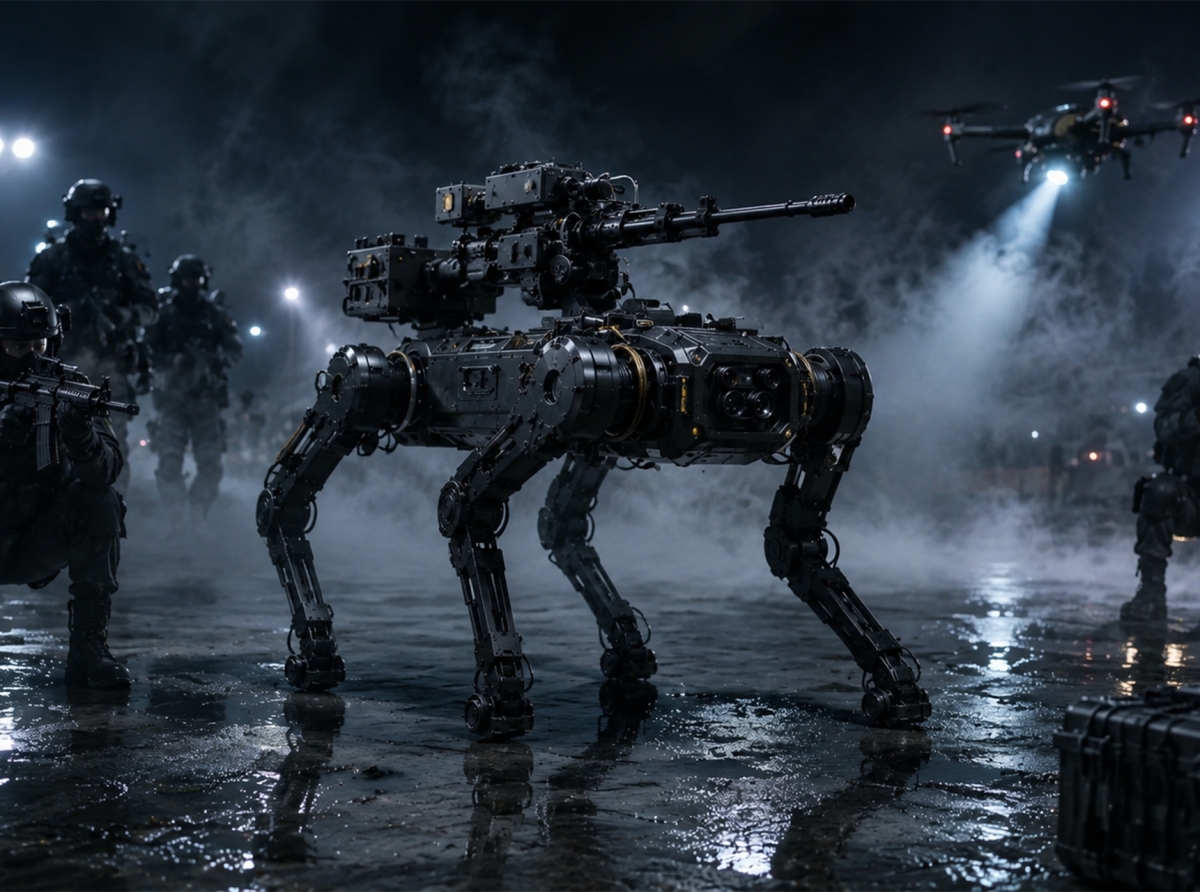
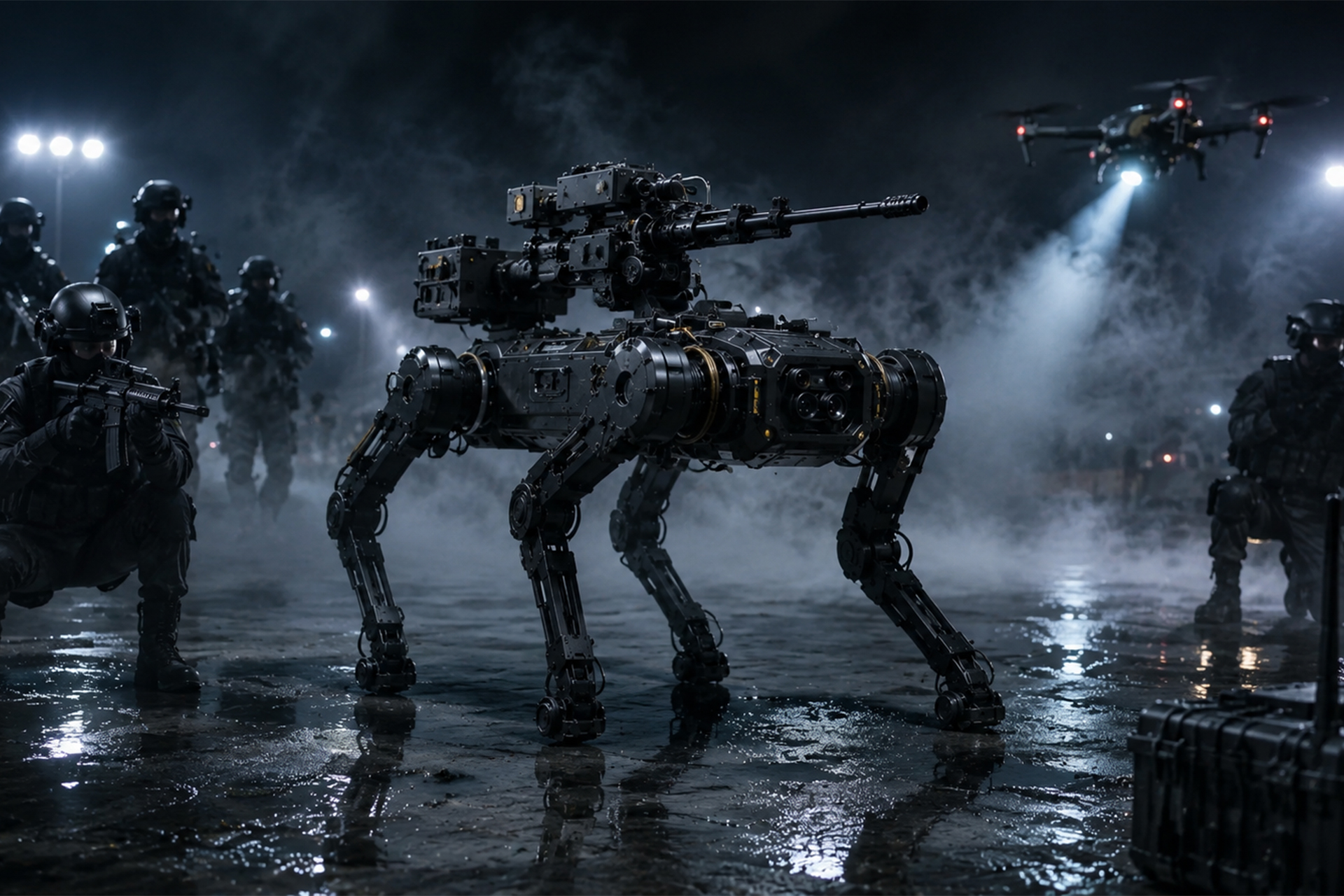
CODiAQ is designed for remote fire support in low‑intensity operations, carrying modular weapons including the 40mm HAVOC and 12‑gauge CHAOS, plus a Targeting Electronics Optical Box. Onboard electronics provide real‑time target acquisition, day/night operation, and ballistic calculation. The robot can navigate rubble, wooded terrain, and urban environments including stairs, with IP67 protection against dust and water.
The contract covers 14 quadruped robots and 28 interchangeable weapon modules. Systems will be transferred for evaluation to USSOCOM and one unnamed foreign ally. Michael Trexler, Skyborne’s government program manager, stated that delivery and operator training with live ammunition are scheduled for October 2026.
CODiAQ is designed for remote fire support in low‑intensity operations, carrying modular weapons including the 40mm HAVOC and 12‑gauge CHAOS, plus a Targeting Electronics Optical Box. Onboard electronics provide real‑time target acquisition, day/night operation, and ballistic calculation. The robot can navigate rubble, wooded terrain, and urban environments including stairs, with IP67 protection against dust and water.
What Is CODiAQ and What Weapons Does It Carry?
CODiAQ is a quadruped robot weighing approximately 50 kg, built on a logistics platform previously developed by Skyborne Technologies. In its combat configuration, it mounts modular weapon systems. According to technical documentation released by the company in April 2026, two primary weapon types are available: the 40mm HAVOC grenade launcher and the 12‑gauge CHAOS shotgun system. Both modules attach to the robot’s back and can be swapped in the field within minutes.Onboard equipment includes a Targeting Electronics Optical Box, which provides real‑time target acquisition, day/night capability, and automatic ballistic calculation to improve accuracy. An electronic stabilisation system allows firing on the move, though developers recommend using CODiAQ from a static position for longer ranges.
A critical feature is that the control system does not require manual command of every movement. One operator works with a handheld controller (about the size of a large tablet), setting waypoints or movement directions, while the robot autonomously navigates obstacles, rubble, and terrain. The system supports autonomous and semi‑autonomous modes, but the decision to open fire remains with the human operator. This aligns with current Pentagon doctrine on “meaningful human control” over lethal autonomous systems.
Armed Robot Dogs CODiAQ to Battle‑Test in US Special Ops
Why Does the Pentagon Need Armed Quadruped Robots Now?
The CODiAQ programme fits into a broader US Department of Defense push to accelerate fielding of AI‑enabled systems and reduce risks to service members. According to the FY2027 budget request published in March 2026, the Pentagon requested $1.2 billion for ground robotic platforms, a 34% increase over 2025. The primary motivation is casualty reduction.In urban combat and building clearance, quadruped robots have advantages over wheeled platforms: they can climb stairs, step over debris, and move through narrow indoor passages. CODiAQ, according to Skyborne, can learn new terrain in minutes: the operator leads the robot through a route once, and it memorises the relief.
For special operations forces, which often operate in small teams in hostile environments, an armed robot can act as a “point shooter”. It moves first into potentially mined areas or kill zones, suppresses enemy fire, and humans follow at a safe distance. Additionally, the robot can carry extra load – ammunition, sensors, or smoke grenades – up to 15 kg beyond the weapon module.
Original expert insight: In practice, CODiAQ’s main advantage is not firepower but the tactical shift of risk. A unit with such a robot can adopt a more aggressive posture because the machine absorbs the first contact. However, this creates a new problem: under combat pressure, an operator may make quicker shooting decisions by relying on the robot’s automation. Ensuring compliance with rules of engagement becomes harder. That is why USSOCOM is conducting extended live‑ammunition trials – not just to test platform reliability but to measure cognitive load on the human.
How Will the Live‑Fire Trials Work and When Can We Expect Results?
Under the contract, Skyborne will deliver 14 robots and 28 interchangeable weapon modules – two weapon options per robot. The company will also provide technical support, maintenance, and repair for 24 months to keep platforms operational throughout the trials. Before field tests, the US military already verified CODiAQ against safety requirements for armed ground robotic systems. Those checks took place at a Virginia test range in April 2026.Michael Trexler, Skyborne’s government program manager, told Defence News on 11 May 2026: “Together with the military, we are preparing delivery of CODiAQ and operator training with live ammunition in October 2026.” Training will occur at a USSOCOM facility, likely Fort Bragg, North Carolina. After training, field exercises will simulate real combat tasks: building assaults, wooded patrols, convoy escort.
The foreign ally receiving several systems has not been officially named. From open‑source agreements and previous robotics cooperation, the most likely candidates are the United Kingdom (UK Special Forces) or Australia (SASR). Skyborne’s Australian origin makes Canberra a strong possibility.
Trial results are expected by the first quarter of 2027. If successful, USSOCOM could initiate a procurement of 200–300 such robots under the FY2028 budget. Simultaneously, the Pentagon is considering including CODiAQ in the Robotic Combat Vehicle (RCV) programme for conventional forces.
Regional Context and the Manufacturer’s Position
Skyborne Technologies is based in Brisbane, Australia, but to fulfill the USSOCOM contract, the company has established final assembly and weapons integration on a production line in Texas. This complies with National Defense Authorization Act (NDAA) requirements for domestic production of critical components. Some electronics and chassis parts come from Australia, making CODiAQ the first US‑Australian cooperative project in combat robotics.For US special operations, this is not the first experience with quadruped robots. In 2023–2025, USSOCOM tested unarmed Ghost Robotics Vision 60 units for reconnaissance and evacuation. However, an armed version capable of live‑fire engagement is being field‑tested for the first time anywhere in the world. China and Russia are also developing similar platforms (e.g., Russia’s Marker and China’s Go1 with grenade launchers), but none have yet completed official military trials with live combat shooting.
Skyborne’s program manager Michael Trexler emphasised that the company has already received inquiries from several NATO countries and Asia‑Pacific partners. “We are focused on completing the USSOCOM contract, but we see huge interest in CODiAQ from Europe and Japan,” he said in a press release on 14 May 2026.
Remaining Questions and Limitations
Despite technological progress, three key challenges remain. First, safety of the robot near humans. If the control system fails or communication is lost, an armed platform becomes a potential danger. Skyborne claims safety protocols include automatic weapon module shutdown if signal is lost for more than 0.5 seconds, but this must be proven in practice.
Second, vulnerability to electronic warfare. The quadruped robot is controlled via an encrypted radio channel. An adversary with powerful electronic warfare systems can jam the signal, after which CODiAQ either stops or (depending on settings) attempts to return to base. Developers have added a limited autonomy mode, but firing without operator confirmation remains blocked.
Third, cost. Although the exact unit price is undisclosed, a 6.5
million contract for 14 robots with two years of support implies an approximate cost of 350,000–400,000 per unit. This is less than the value of a soldier’s life in terms of insurance and compensation, but more expensive than many drones. Mass adoption would require price reduction.
The central question today, as analysts at the Center for a New American Security (CNAS, report April 2026) note, is not whether a robot can carry a weapon, but how safely and predictably the military can employ such a platform in close proximity to humans. The CODiAQ trials in October 2026 will provide the first answer.
The Pentagon is taking an armed quadruped robot to combat trials for the first time within special operations forces. Skyborne’s CODiAQ is not a gimmick – it is an attempt to create a new tactical squad member: a machine that absorbs the first shot, carries weapons, and navigates rough terrain. The success or failure of this programme will determine whether armed robot dogs become a 2030 standard or remain an expensive experiment. For investors and defence analysts, the signal is clear: ground robotic systems with AI and weapons are moving from laboratories to real battle orders. The question is no longer about technology – it is about the rules of engagement.
By Jake Sullivan
May 15, 2026
Join us. Our Telegram: @forexturnkey
All to the point, no ads. A channel that doesn't tire you out, but pumps you up.
May 15, 2026
Join us. Our Telegram: @forexturnkey
All to the point, no ads. A channel that doesn't tire you out, but pumps you up.





Report
My comments