


SpaceX Space Data Centers: 1M Satellites Explained
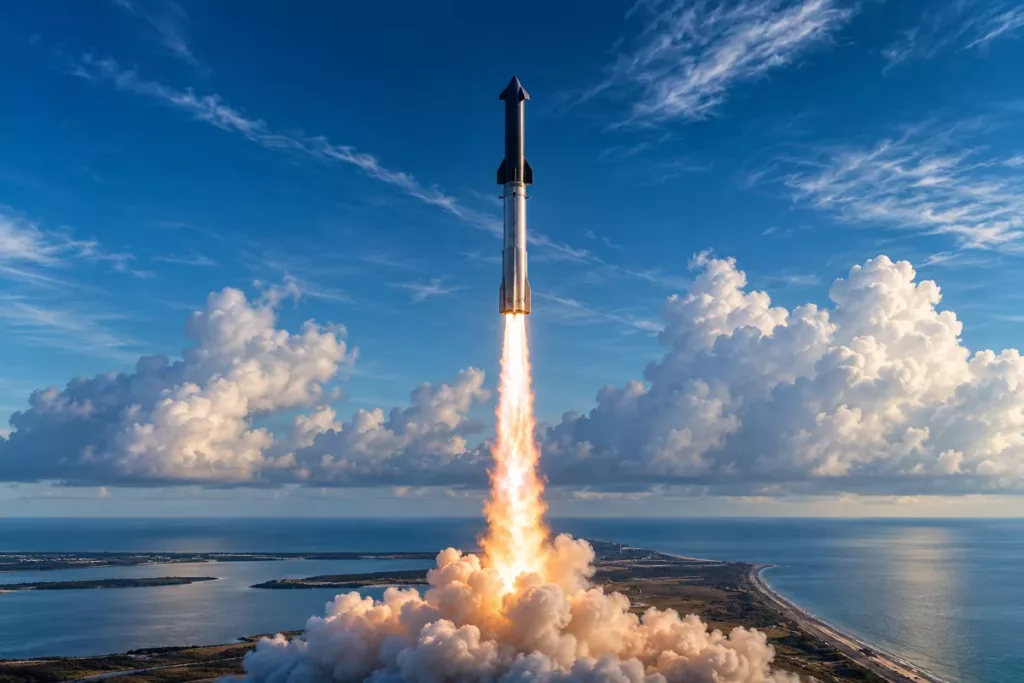
SpaceX Space Data Centers: What 1 Million Satellites Could Mean for AI
SpaceX space data centers could become a new part of the infrastructure supporting artificial intelligence if the company receives authorization to deploy its proposed orbital network. The reported US regulatory decision concerns a potential constellation of up to one million satellites designed to support computing infrastructure in space. The proposal connects two rapidly developing industries: satellite communications and AI computing. However, authorization to develop a project should not be confused with the deployment of one million operational satellites. The financial significance lies in the potential economics of orbital computing, including launch costs, power supply, cooling, communications and capital expenditure. For investors and technology companies, the development raises a broader question: could computing infrastructure eventually expand beyond terrestrial data centers, and what commercial and regulatory obstacles would determine whether that model becomes viable?
What did the FCC actually approve?
The decision was issued on November 25, 2026, by the Federal Communications Commission (FCC), the US regulator responsible for communications licensing. It authorizes SpaceX to deploy and operate a constellation of up to one million orbital computing modules under the name Starmind.
The distinction between approval and implementation is essential. The FCC has granted regulatory authorization; it has not confirmed that SpaceX has built the satellites, established the necessary computing infrastructure or demonstrated that the project can operate profitably.
According to the FCC’s November 25 announcement, the system is intended to process substantial volumes of data in orbit and transmit the results back to Earth. The authorization also covers radiofrequency communications for backup and emergency telemetry, tracking and command operations, supplementing optical inter-satellite links. FCC announcement, November 25, 2026.
The project has several important characteristics:
| Parameter | Approved project |
| Company | SpaceX |
| Project name | Starmind |
| Authorized constellation | Up to 1 million satellites |
| Primary function | Orbital data processing |
| Main application | AI computing infrastructure |
| Network architecture | Optical inter-satellite links, with radiofrequency backup |
| Regulatory authority | US Federal Communications Commission |
| Decision date | November 25, 2026 |
The scale is unprecedented for an orbital data-center project. However, the authorized maximum should not be interpreted as a confirmed launch schedule or a forecast of the number of satellites that will eventually become operational.
The regulatory timetable provides a more realistic way to assess the project. According to the American Astronomical Society’s November 25 statement, SpaceX must begin deployment by November 2033, place 100,000 satellites in orbit by November 2035 and complete deployment of the authorized constellation by November 2040. These milestones turn an ambitious technological proposal into a long-term infrastructure commitment.
Why does SpaceX want to move AI data centers into orbit?
The main economic motivation is energy.
AI models require substantial computing capacity. Training large models and operating inference systems — the process through which a trained model generates answers or predictions — require specialized processors, electricity and cooling infrastructure.
Terrestrial data centers face several constraints:
- Access to large and reliable electricity supplies.
- Availability of suitable land and grid connections.
- Cooling requirements and water consumption.
- Construction costs and lengthy infrastructure approvals.
- Increasing competition for power capacity between industrial and digital infrastructure.
SpaceX’s proposed orbital architecture attempts to address some of these limitations by placing computing equipment in low Earth orbit, where satellites can receive solar energy.
Solar panels could provide a relatively continuous energy supply, potentially reducing dependence on terrestrial electricity networks. SpaceX has also argued that orbital infrastructure could reduce operating and maintenance costs compared with conventional data centers.
But the economic argument requires qualification. Solar power in orbit is not free computing. Satellites need photovoltaic equipment, power-management systems, radiation protection, thermal control, processors and communications hardware. Equipment must also be launched, maintained or replaced.
There is a further distinction between generating electricity and delivering usable computing capacity. A satellite may have access to solar energy, but the cost of turning that energy into reliable processing capacity and transmitting results to customers remains a separate commercial challenge.
For this reason, orbital computing should be viewed as an emerging infrastructure model rather than an established alternative to terrestrial cloud services.
How could orbital computing change the AI infrastructure market?
If the technology becomes commercially viable, SpaceX could influence the structure of the global AI infrastructure market.
The potential change is not simply the relocation of servers. It is the creation of a computing network that combines satellites, onboard processors, optical communications and ground-based infrastructure.
One possible architecture involves processing data in orbit before sending the results to Earth. This could reduce the need to transmit every raw data stream to terrestrial facilities, particularly for applications involving satellite imagery, Earth observation and space-based monitoring.
For example, an orbital system could process satellite images locally, identify relevant objects and transmit a smaller analytical output rather than transferring the entire original dataset.
For AI infrastructure providers, this introduces a new competitive variable: the location and energy economics of computing capacity.
| Market segment | Potential impact |
| AI infrastructure | An additional location for computing capacity |
| Cloud computing | Possible new orbital processing services |
| Satellite communications | Greater integration of computing and connectivity |
| Semiconductor industry | Demand for radiation-tolerant computing hardware |
| Launch services | Additional demand for payload transportation |
| Energy infrastructure | Greater interest in space-based solar generation |
However, the impact on existing cloud providers is unlikely to be immediate. Terrestrial facilities already benefit from established supply chains, maintenance networks, fiber connections and customer infrastructure. Orbital data centers would need to demonstrate comparable reliability and competitive costs.
The most plausible initial applications may therefore be specialized workloads that benefit directly from processing data in space, rather than a wholesale replacement of conventional data centers.
What are the main technological and environmental risks?
The scale of Starmind creates challenges that do not exist in the same form for conventional data centers. The most important risks concern satellite reliability, orbital congestion, radiation exposure, heat dissipation and the cost of replacing equipment.
- Radiation and hardware reliability. Processors operating in orbit face cosmic radiation and solar activity. Radiation can cause electronic errors, damage components and shorten equipment lifetimes. Unlike a server in a terrestrial facility, an orbital computing module cannot be easily accessed by technicians for routine repairs.
- Cooling and thermal management. Space provides no conventional atmosphere through which heat can be dissipated. Satellites must use radiators and other thermal-management systems to remove the heat generated by processors. The engineering requirements become more demanding as computing density increases.
- Launch and replacement costs. Even if reusable rockets reduce transportation expenses, deploying and maintaining a constellation of one million satellites would require a substantial launch programme. The economics depend on payload capacity, launch frequency, manufacturing costs and the operational lifetime of each satellite.
- Orbital debris and collision risks. A larger satellite population increases the complexity of traffic management. Collisions can generate debris that threatens other spacecraft and creates additional operational costs.
The FCC addressed some of these issues in its November 25, 2026 order. It imposed reporting requirements covering orbital conjunction events, satellites removed from operation, atmospheric reentries and deployment figures. However, the regulator deferred SpaceX’s request to use alternative disposal methods for satellites above 600 km because the company had not provided sufficient information to establish compliance with disposal requirements. FCC Order DA 26-1273, November 25, 2026.
There are also concerns about the impact on astronomy. The American Astronomical Society (AAS), in its November 25 response, warned that the proposed constellation could interfere with optical, infrared and radio astronomy. Its concerns include satellite brightness, radio emissions, thermal radiation and atmospheric pollution associated with launches and reentries. The organization had previously petitioned the FCC to deny the application.
The FCC, meanwhile, concluded that certain environmental and astronomical issues raised in the proceedings fell outside the scope of its authority. This means regulatory approval should not be interpreted as a finding that the project has no environmental consequences.
The controversy illustrates a broader problem for the space industry: commercial expansion is creating infrastructure requirements faster than existing governance frameworks can address every associated risk.
What does the SpaceX decision mean for investors and financial markets?
For investors, the FCC decision is primarily a long-term infrastructure development signal, not an immediate earnings catalyst.
The authorization strengthens SpaceX’s ability to pursue orbital computing, but it does not establish a commercial revenue model, confirm customer demand or prove that the cost per computing unit will be competitive with terrestrial alternatives.
SpaceX’s own securities disclosure provides an important qualification. In its 2026 SEC registration materials, the company described orbital AI computing as an unproven technology with significant technical complexity. It warned that the necessary systems had not previously been operated commercially in orbit and that the initiative might never achieve commercial viability. The filing also identified the risks of component failure, expensive replacement, launch delays and changing market demand.
This is particularly relevant because the project requires long-term capital allocation. Investors need to distinguish between three different stages:
| Development stage | What it establishes | Financial significance |
| Regulatory authorization | Permission to proceed under specified conditions | Reduces one regulatory barrier |
| Successful technical deployment | Demonstrates that orbital computing equipment can operate | Provides evidence of technical feasibility |
| Commercial operation | Demonstrates customer demand and sustainable unit economics | Establishes the basis for recurring revenue |
The first stage has now been achieved. The other two remain to be demonstrated.
For semiconductor manufacturers, the project could eventually create demand for radiation-tolerant processors, specialized memory and power-efficient computing components. Launch-service providers could benefit from additional payload demand, while companies developing satellite communications and optical networking technologies may find new commercial opportunities.
However, these potential beneficiaries should not be treated as automatic investment winners. The timing, scale and distribution of any resulting revenue remain uncertain.
The development also belongs in the wider debate about AI capital expenditure. Technology companies are investing heavily in processors, data centers, electricity infrastructure and networking. SpaceX’s proposal adds another potential destination for that capital.
The wider AI infrastructure investment and market-risk debate is relevant here: growing demand for computing does not automatically guarantee that every infrastructure investment will generate an adequate return.
For Forex traders, the immediate implications are more indirect. Developments in AI infrastructure can influence sentiment toward technology companies, semiconductor manufacturers and growth-oriented equities. These movements can affect broader risk appetite, equity-market volatility and, at times, demand for traditional safe-haven currencies.
Nevertheless, the FCC decision alone does not provide a reliable basis for forecasting movements in EUR/USD, USD/JPY or other currency pairs. Its financial significance will depend on subsequent evidence of investment, commercial deployment and measurable economic returns.
What should the market watch next?
The most useful indicators will be operational rather than promotional.
Investors and technology-sector analysts should monitor five developments:
- First operational satellite: whether SpaceX places a Starmind module into its assigned orbit and demonstrates functioning computing capability by the regulatory deadline.
- Launch economics: whether Starship and other launch infrastructure can deliver the required payload capacity at commercially sustainable costs.
- Computing performance: how orbital processors perform under radiation, thermal and power constraints.
- Commercial demand: whether AI developers, cloud providers and other customers are willing to purchase orbital computing services.
- Regulatory compliance: whether SpaceX meets deployment milestones and provides the required orbital-safety and interference reports.
These indicators will help distinguish a large infrastructure ambition from a commercially functioning business.
The FCC’s timetable is especially important. SpaceX must deploy its first authorized operational satellite by November 25, 2033, reach 10% of the approved constellation by November 25, 2035, reach 50% by November 25, 2038 and complete deployment by November 25, 2040. Failure to meet the specified milestones would cause the authorization to become null and void.
The long implementation period also means that changes in semiconductor technology, terrestrial energy prices, AI demand and reusable launch economics could materially alter the project’s business case before full deployment.
Conclusion: SpaceX space data centers remain a long-term bet
SpaceX space data centers represent a significant regulatory milestone in the convergence of artificial intelligence, satellite communications and space infrastructure. The FCC’s authorization for up to one million Starmind satellites gives the company a framework to pursue orbital computing at an unprecedented proposed scale.
For investors, however, permission to deploy is not proof of profitability. Radiation protection, thermal management, launch costs, orbital safety and customer demand will determine whether the concept can become a sustainable business.
The most important question is no longer whether SpaceX can obtain regulatory permission. It is whether the company can demonstrate that computing in orbit can deliver measurable economic advantages over infrastructure on Earth. Until that evidence emerges, Starmind should be treated as a major long-term technology development rather than an established commercial market.
By Jake Sullivan