

AI Stocks Sell-Off: Why Anthropic IPO Failed to Help

The AI stocks sell-off continued on Nov 20, 2026, despite Anthropic’s record-breaking stock market debut. The company behind Claude raised $81.3 billion in its IPO, and its shares gained 17.1% on their first trading day. However, the positive reception did not translate into a recovery across the technology sector. The S&P 500 fell 2% on Nov 19, while the Nasdaq Composite lost 2.3%. Asian markets extended the decline the following morning, with Japan’s Nikkei 225 and South Korea’s Kospi each falling 4.5%. The divergence highlights a growing problem for the AI investment theme: investors are questioning whether enormous infrastructure spending, elevated valuations and future earnings expectations can be reconciled. A successful IPO can attract capital to one company without restoring confidence in the entire sector.
Why Anthropic’s record IPO failed to revive AI stocks
Anthropic’s IPO demonstrated that investor demand for leading artificial intelligence companies remains substantial. It did not demonstrate that the broader AI sector has overcome its valuation problems.
The Claude developer priced its shares at $83, raised approximately $81.3 billion and began trading on Nasdaq on Nov 19. The stock opened at $111.50, climbed to $115.10 and closed at $97.17, delivering a 17.1% gain against the offering price. The initial valuation was approximately $1.5 trillion, making the transaction the largest stock market debut on record. These figures illustrate the scale of demand for access to a major private AI developer.
However, the performance of an individual IPO and the direction of an entire technology sector are two different market signals.
Investors buying Anthropic shares were purchasing exposure to a new publicly traded AI business. Existing technology companies faced a different test: whether their current valuations adequately reflected future revenue, operating costs and investment requirements. A strong debut for one company does not automatically improve the earnings outlook for semiconductor manufacturers, cloud providers or software developers.
There is also a portfolio-allocation effect. Institutional investors have limited capital and may redistribute holdings when a major new listing becomes available. Some funds could reduce exposure to established technology shares to finance positions in Anthropic. This is a possible explanation for divergent performance, although the available market data does not establish that IPO-related reallocations caused the wider decline.
The more significant issue is the difference between enthusiasm for AI technology and confidence in the financial returns generated by AI investments. The first remains visible in demand for Anthropic shares. The second is under pressure.
Why Wall Street and Asian technology markets are falling
The decline on Wall Street showed that the IPO was insufficient to reverse an established selling trend. On Nov 19, the S&P 500 initially gained as much as 1.3% after Anthropic began trading, but subsequently reversed direction and closed 2% lower at 7,175.83. The Dow Jones Industrial Average dropped 2.2% to 49,097.06, while the Nasdaq Composite lost 2.3% to 23,879.20.
The next trading session brought further pressure across Asia. On the morning of Nov 20, the Nikkei 225 and Kospi each declined 4.5%. Australia’s S&P/ASX 200 lost 1.6%, Hong Kong’s Hang Seng fell nearly 2%, and the Shanghai Composite declined 1.7%. (Associated Press, Nov 20, 2026.)
The concentration of losses in technology-related shares is particularly important. Companies such as Samsung Electronics, Advantest, SoftBank and Tencent came under pressure. These businesses operate in different segments of the technology industry, but their valuations are influenced by expectations surrounding AI adoption, computing demand and investment in digital infrastructure.
The international nature of the semiconductor supply chain makes this relationship especially relevant. American technology companies depend on Asian manufacturers for memory chips, semiconductor production and specialised equipment. When investors reassess expected AI infrastructure spending, the effect can spread across several markets.
Taiwan also remains an important part of this picture because of its position in advanced semiconductor manufacturing. Weakness in the region can therefore reflect concerns about the outlook for the global chip industry rather than an isolated domestic market problem.
Nevertheless, a sharp decline over one or two sessions should not automatically be classified as the beginning of a prolonged bear market. Traders need to distinguish between a temporary reduction in risk exposure, a sector rotation and a sustained deterioration in corporate earnings expectations.
AI valuations and infrastructure spending create pressure
The central challenge for AI-related companies is the relationship between investment costs and future profitability.
Developing and operating advanced AI models requires substantial computing capacity, specialised chips, energy, data centres and technical infrastructure. These investments can support future growth, but they also create significant financing requirements. Companies must eventually demonstrate that the revenue generated by AI products and services can justify the associated expenditure.
This creates different risks for different parts of the sector.
Semiconductor manufacturers may benefit from demand for advanced processors, but their revenue expectations depend on continued investment by major technology customers. Cloud providers can generate income from AI computing services, although expanding infrastructure requires capital expenditure. AI developers must attract customers willing to pay enough for their products to cover model development, computing and operational costs.
The distinction matters because strong demand for AI applications does not necessarily translate into equally strong returns for every company supplying the technology.
Financing conditions add another layer of uncertainty. When borrowing costs remain elevated, debt-funded infrastructure projects become more expensive. At the same time, higher interest rates reduce the present value of future earnings, putting pressure on companies whose valuations depend heavily on profits expected several years ahead.
The market is therefore assessing two connected questions: how quickly AI adoption will expand and how much of that growth can ultimately become shareholder returns.
A company can report increasing demand while its shares decline if investors believe that the expected growth is already reflected in its valuation. This is one reason why positive corporate news does not always produce a sustained rally in technology stocks.
The wider financial environment also matters. Expectations of further Federal Reserve tightening can increase pressure on growth-oriented equities. Even without an immediate policy change, a shift in interest-rate expectations can alter portfolio valuations and encourage investors to reduce exposure to higher-risk assets.
What traders should monitor after the AI market correction
The next stage of the correction will depend on whether selling remains concentrated in AI-related shares or spreads across the broader equity market.
The first indicator is market breadth. If semiconductor companies continue to weaken while financial, industrial and consumer sectors remain relatively stable, the move may represent a sector-specific reassessment. If declines become widespread, the probability of a broader risk-off environment increases.
The second indicator is corporate guidance. Traders should examine announcements from semiconductor manufacturers, cloud providers and technology companies for changes in capital expenditure plans, customer demand and revenue expectations. Management commentary about future spending can be more informative than a short-term movement in share prices.
The third factor is the behaviour of government bond yields and interest-rate expectations. A sustained increase in yields can make expensive growth stocks less attractive, particularly when their projected earnings lie far in the future. Conversely, easing financing pressure could support a recovery in valuations, although it would not resolve company-specific profitability concerns.
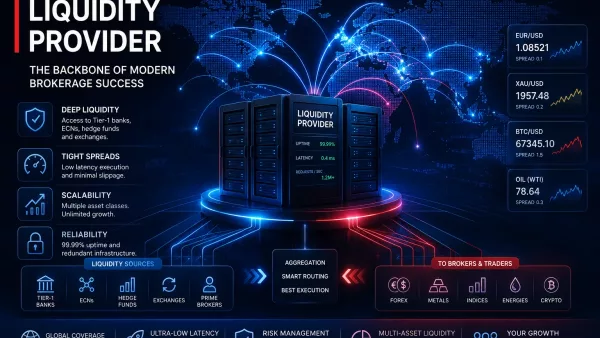
The fourth factor is volatility and liquidity. During rapid market declines, bid-ask spreads can widen and price gaps can become more frequent. Traders using leveraged positions should account for the possibility that stop orders may execute at prices different from those anticipated. The mechanics of market quotations and execution are explained in FX24’s guide to the price feed infrastructure used by Forex brokers.
Finally, investors should assess AI companies individually rather than treating the entire industry as a single asset class. Semiconductor producers, infrastructure operators, cloud platforms and AI software developers have different revenue structures, cost bases and financing needs. Their share prices may respond differently to the same market event.
A correction in the sector can therefore create both opportunities and risks, depending on the underlying business and the reason for the decline. The key is to distinguish a temporary valuation adjustment from a lasting deterioration in the economics of AI.
Conclusion: Anthropic’s success does not guarantee an AI market recovery
Anthropic’s record IPO confirmed strong investor interest in major artificial intelligence companies, but it did not eliminate concerns about the wider sector. The contrasting performance of its shares and global technology benchmarks highlights the growing importance of valuation discipline, infrastructure costs and financing conditions.
For traders, the most useful signals will be market breadth, semiconductor performance, corporate spending guidance and interest-rate expectations. A sustainable recovery requires more than another successful listing or a temporary rebound in technology shares. It requires evidence that AI-related investment can generate returns consistent with the expectations already built into market valuations.
By Miles Harrington