


CRM for Forex Brokers: Why It Matters and What Features to Look For
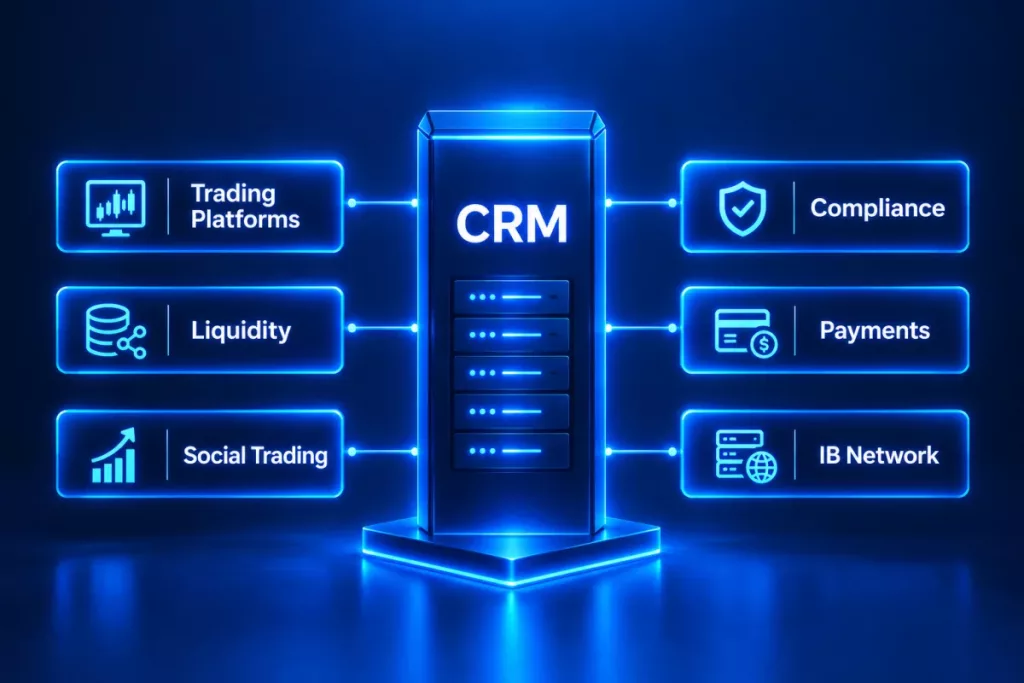
CRM for Forex Brokers is an operational system that connects client management with the trading, compliance, payment and partner infrastructure of a brokerage. Unlike a generic sales CRM, a forex brokerage CRM must account for trading-account structures, onboarding requirements, identity verification, Introducing Broker (IB) relationships, funding workflows and integrations with trading platforms. Its role is to coordinate processes and synchronize information across connected systems, not to replace the trading platform or execute trades independently. The exact capabilities depend on the platform, API and implementation.
For brokers, the most important selection criteria are infrastructure compatibility, integration depth, data security, scalability and the ability to maintain reliable operational records. A feature-rich CRM can still become a bottleneck if its integrations are incomplete or its data model conflicts with the brokerage’s existing systems. The right solution should fit the broker’s business model, support its required workflows and preserve clear ownership of client, account and transaction data.
Why Does a Forex Brokerage Need a Dedicated CRM?
A brokerage operates across several interconnected functions. Client acquisition, account registration, verification, deposits, trading activity, customer support and partner commissions may involve different applications and service providers. Without a reliable coordination layer, teams can end up working with inconsistent records, repeating manual tasks and making decisions without a complete view of the client relationship.
A dedicated forex brokerage CRM connects these processes through shared client records, configurable workflows and system integrations. It helps sales teams track prospects, gives operations staff visibility into onboarding, and allows support teams to access relevant client history according to their permissions. Management can also use consolidated reporting to understand conversion, account activity and operational bottlenecks.
The key distinction is that a CRM is not necessarily the authoritative source for every type of data. A trading platform manages its supported account and trading functions; a payment service provider processes payments; and a verification service performs the checks it is contracted to provide. The CRM coordinates the relevant workflows and records information received from these systems.
Consider a client who registers through a marketing campaign, submits identity documents and requests a live trading account. The CRM can assign the application to the appropriate workflow, initiate supported verification steps, request account creation through an integration and track the resulting status. If verification fails or the account-creation request encounters an error, the workflow should expose the exception instead of presenting the process as complete.
This architecture becomes increasingly valuable as a broker adds trading platforms, jurisdictions, payment methods or partner channels. However, centralization alone does not guarantee accuracy. The systems must exchange data consistently, and the brokerage must define which application owns each record and decision.
Which Forex CRM Features Matter Most?
The right feature set depends on the brokerage’s business model and operating requirements. Rather than evaluating a CRM by the number of modules in its product brochure, brokers should examine whether the available functions support their actual workflows and integrate with the systems already in use.
KYC, onboarding and compliance workflows
A brokerage CRM should support client registration, document collection, verification status, review queues and an auditable history of relevant decisions. Integration with external identity verification, sanctions-screening or anti-money-laundering tools may reduce repetitive work, but availability and scope must be confirmed with each provider.
A CRM should not automatically mark a client as approved simply because documents were uploaded or an external service returned a partial result. The workflow must distinguish submission, verification, manual review and final approval wherever those stages apply. Compliance requirements depend on the broker’s activities and jurisdictions.
Client segmentation and lifecycle management
Segmentation allows brokers to organize clients by lifecycle stage, account status, engagement and other permitted business criteria. These records can support targeted communication, service prioritization and retention analysis.
Useful capabilities include configurable client groups, communication history, task assignment, inactivity monitoring and campaign attribution. If trading activity is used to create segments, the broker should verify the data source, update frequency and permissions governing access to that information.
IB and partner management
Introducing Brokers and affiliates can be important acquisition channels. A specialist CRM may support referral attribution, partner hierarchies, commission rules, performance reports and payout workflows.
The critical requirement is traceability. A broker should be able to determine which rules generated a commission amount, which transactions contributed to the calculation and whether the amount has been approved or paid. Referral attribution and commission calculation should not depend on undocumented manual adjustments.
Payments, reporting and operational visibility
A CRM may integrate with payment service providers to track deposit and withdrawal requests, expose processing statuses and associate transactions with client records. It should distinguish between a submitted request, an approved instruction, a completed payment and a reconciled transaction.
Reporting should use consistent definitions. For example, the number of withdrawal requests is not the same as the number of completed payouts. Similarly, registered clients, verified clients and funded accounts represent different stages of the client journey.
Retention and client support
Customer support tools can centralize tickets, previous interactions and escalation history. Lifecycle automation can help teams identify unresolved requests or clients whose activity has changed.
Retention features should support appropriate service and communication, not replace sound business judgment with an unexplained score. Brokers should understand the data behind any behavioral classification and ensure that access and communication practices comply with applicable requirements.
How Does CRM Integration Fit Into a Broker’s Technology Stack?
CRM integration is the process of connecting client-management workflows with the systems that provide trading, payments, compliance, marketing and other brokerage functions. Integration quality matters because a CRM that cannot exchange information reliably may create more manual work than it removes.
A typical brokerage technology stack can include:
|
System |
Integration purpose |
| MT4, MT5 or cTrader | Supported account operations and trading-related data |
| Liquidity and execution infrastructure | Relevant order, execution or account information where supported |
| Payment service providers | Funding requests, payment statuses and transaction references |
| KYC and AML providers | Verification results and review statuses |
| Marketing platforms | Lead attribution, campaigns and consent-related information |
| Social trading and PAMM systems | Client access, service participation and supported account workflows |
| Prop trading technology | Challenge registration, account association and evaluation status |
The precise data exchanged depends on each provider’s interface, permissions and integration scope. A product listing or an available API should not be interpreted as proof that every required workflow is supported.
Before implementation, brokers should map data ownership. For example, the payment provider may be authoritative for external payment execution, while the CRM maintains the client-facing workflow and the trading platform records account-related information. Synchronization rules should explain what happens when updates arrive late, conflict with existing records or fail completely.
Integration testing should cover both successful and unsuccessful scenarios. A useful test might include a client whose verification is approved but whose account creation fails, or a withdrawal request whose status remains pending at the payment provider. The team should be able to identify the current state, the system responsible for it and the action required to resolve the issue.
API access also introduces security and maintenance responsibilities. Brokers should review authentication, permissions, logging, error handling, version changes and recovery procedures. A connection that works during a demonstration may still be unsuitable for production if failures cannot be detected or reconciled.
What Security and Compliance Controls Should a Broker Check?
A forex CRM may contain personal information, identity documents, client communications and sensitive operational records. Security must therefore be evaluated as part of the overall architecture rather than as an isolated feature.
For brokers processing personal data within the scope of the EU General Data Protection Regulation (GDPR), Article 5 sets out principles including data minimization, accuracy, purpose limitation and integrity and confidentiality. Article 32 addresses security measures appropriate to risk. The regulation was adopted on April 27, 2016, and published in the EU Official Journal on May 4, 2016. The official text is available through EUR-Lex.
During vendor evaluation, examine role-based access controls, multifactor authentication, encryption, audit logs, backup procedures and incident response. Confirm whether the system records important changes, including verification decisions, permission changes and sensitive account-related actions. Ask how access is restricted for external support staff and how permissions are reviewed when employees or contractors change roles.
Data governance also matters. Determine where records are stored, which subprocessors can access them, how long information is retained and how data can be exported when changing providers. Contractual and technical arrangements should cover incident notification, service continuity, data portability and the division of security responsibilities.
For regulated brokers, a CRM can support compliance workflows and evidence collection, but software functionality does not establish regulatory compliance by itself. The brokerage must assess its applicable obligations, configure the system appropriately and maintain oversight of the processes it operates.
How Should Brokers Choose a CRM for Their Business Model?
CRM selection should begin with a map of the brokerage’s operating requirements. Identify the client journey, current systems, manual handoffs, required integrations and the problems that create the greatest cost or operational risk. Then evaluate vendors against the same criteria.
| Broker profile | Primary CRM priorities | Risk to assess |
| Startup brokerage | Core integrations, onboarding and scalability | Dependence on manual processes |
| Growing brokerage | Automation, reporting and lifecycle management | Operational bottlenecks |
| Regulated brokerage | Auditability, access control and compliance workflows | Inadequate oversight or records |
| Enterprise brokerage | Multi-system compatibility and data governance | Fragmented architecture and migration complexity |
These profiles are indicative rather than fixed categories. A smaller broker may have demanding integration requirements, while a larger business may need to replace only one component of its existing stack.
Request demonstrations using real operating scenarios. Test registration, verification, trading-account creation, funding-status updates, partner commission calculations and error handling. Ask vendors to show how the system records changes and what happens when an integration becomes unavailable.
Total cost of ownership should include implementation, customization, API access, hosting, support, maintenance and future migration. The cheapest initial proposal may be more expensive over time if the broker needs extensive custom development or must reconcile disconnected records manually.
CRM integration with TSG Solutions
TSG provides trading-related technology, including PAMM and Prop. Its official CRM integrations directory lists connections with CRM and back-office providers for these products.
For brokers evaluating this ecosystem, the practical next step is to confirm the required combination of CRM, trading platform and TSG product. The teams involved should agree on supported functions, data exchange, permissions, account mapping, testing responsibilities and production support before committing to a deployment.
A modular setup can help brokers introduce additional trading services without replacing the entire client-management system. However, the outcome depends on the integration scope and the way the systems are configured. Compatibility should be demonstrated for the intended workflow rather than inferred from general product descriptions.
Conclusion
A CRM for Forex Brokers should be selected as part of the brokerage’s operating architecture, not as a standalone sales tool. Its value depends on how effectively it coordinates onboarding, client records, compliance workflows, payments, IB relationships and trading-related services while preserving clear data ownership. Brokers should prioritize integration compatibility, security, auditability and lifecycle automation, then verify the actual behavior of each critical workflow through testing. The strongest choice is the system that fits the brokerage’s current infrastructure and growth plans without introducing unnecessary complexity, hidden dependencies or costly migration risks.
By Miles Harrington