

US Supply Chains vs China: 3 Critical Risks Investors Must Watch
Are US Supply Chains More Vulnerable Than China’s?
3 Critical Risks Investors Must Watch
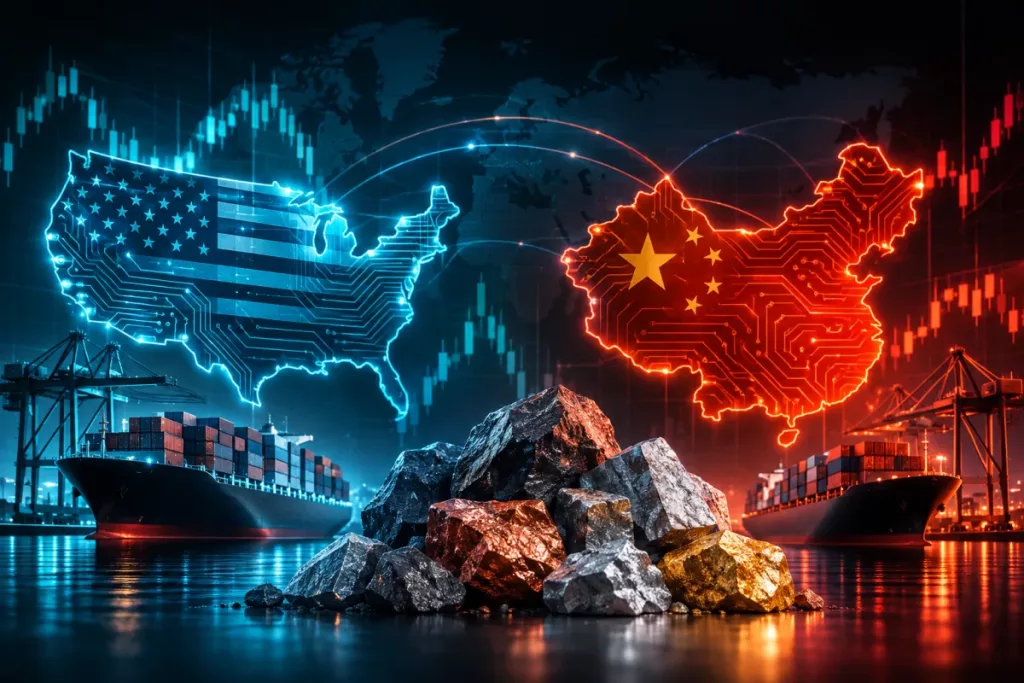
US supply chains look more exposed to China than China’s supply chains look exposed to the United States — at least when measured by the concentration of critical imports. China supplies about 31% of America’s most vulnerable import categories, while the United States supplies roughly 8% of China’s equivalent imports. Yet the comparison is not a simple scorecard of American weakness versus Chinese strength.
The more important point for investors, corporate buyers and policymakers is that both economies rely on inputs that are difficult to replace quickly. The United States has concentrated exposure to Chinese-processed rare earths, critical chemicals and selected industrial components. China, in turn, remains dependent on advanced semiconductors, imported crude oil and iron ore.
That makes supply-chain risk a market issue, not merely a logistics issue. A disruption in a single input can raise production costs, delay output, lift inflation expectations and change the outlook for technology, energy, industrials and defense stocks.
What Makes a Supply Chain Vulnerable?
A supply chain becomes vulnerable when several conditions overlap. The first is product criticality: the input is essential for defense, advanced manufacturing, healthcare, energy infrastructure or digital technology. The second is supplier concentration: one country, company or processing hub controls a large share of available supply. The third is geopolitical distance: the trade flow depends on countries with conflicting strategic interests or unstable relations.
A fourth factor is often overlooked: limited substitution. Even if alternative suppliers exist, they may lack the processing capacity, technical certification, scale or logistics routes needed to replace a disrupted source quickly. This is why “friend-shoring” does not automatically remove risk. A factory may move to Vietnam, Mexico or India, while a key material or component still originates in a concentrated upstream market.
Recent analysis of roughly $19 trillion in global goods trade found that about $4 trillion carries at least two of the main vulnerability factors. The share of global imports considered highly vulnerable has risen from 15% in 2000 to 23% in 2024. Globalization has not disappeared; it has become more concentrated, more politicized and harder to reroute.
Why US Supply Chains Face Greater Exposure
The clearest imbalance concerns China’s role in US critical imports. China accounts for about 31% of America’s most vulnerable import categories, compared with only 8% for the United States in China’s equivalent import mix.
The exposure is especially visible in rare earth elements. China produces around 91% of the world’s refined rare earths, materials used in electric vehicles, wind turbines, smartphones, defense systems and advanced manufacturing.
This does not mean every US company buys directly from Chinese suppliers. But many products assembled in the United States, Europe, Japan or Southeast Asia may still rely on Chinese-processed materials, components or chemicals somewhere upstream. Country-of-origin labels therefore do not reveal the full risk.
|
Supply-chain factor |
United States |
China |
| Share of most vulnerable imports supplied by the other economy | 31% | 8% |
| Main concentration risk | Rare earths, critical chemicals, selected components | Advanced semiconductors, imported energy, iron ore |
| Main policy lever | Export controls and technology restrictions | Export controls and critical-material processing |
| Core strategic challenge | Reducing dependence on concentrated inputs | Securing technology, energy and raw materials |
Why China Is Not Immune
China’s supply-chain position is powerful, but it is not risk-free. The country remains dependent on advanced semiconductors, where US export controls can restrict access to leading-edge chips, equipment and design tools.
China also imports large volumes of crude oil and iron ore, including from Australia. These are not marginal purchases: they support manufacturing, infrastructure, transport and industrial output. A disruption to shipping routes, energy supplies or raw-material flows can therefore affect Chinese production even when domestic manufacturing capacity is strong.
In practical terms, China has leverage in rare earths, batteries and many industrial materials. The United States retains leverage in advanced technology, financial infrastructure and parts of the global energy system. The vulnerability is mutual, but it is concentrated in different places.
How Supply-Chain Risk Moves Markets
Supply-chain disruptions can affect markets through several channels. Higher input costs can compress corporate margins, especially for manufacturers with limited pricing power. Longer lead times can delay revenue recognition and force companies to hold more inventory, tying up working capital.
Energy is particularly important. Rising oil prices increase transport, manufacturing and logistics costs, while also feeding into inflation expectations. That can influence bond yields, currency movements and expectations for central-bank policy.
For equity investors, the impact is uneven. Technology companies may face pressure from semiconductor restrictions and component shortages. Energy producers can benefit from higher crude prices. Industrial firms may face a mixed outcome: stronger demand can support revenue, while higher input costs can reduce margins.
What Companies Should Do Now
Businesses that treat supply-chain resilience as a compliance exercise may be underestimating the risk. The more effective approach is to treat it as a strategic investment in operational continuity.
Map the Full Chain
Companies should identify not only direct suppliers but also tier-two and tier-three suppliers. The most dangerous risks often sit several layers below the visible contract manufacturer. A firm may know its immediate component supplier, yet have limited visibility into the mine, refinery, chemical plant or equipment maker further upstream.
Diversify Beyond Geography
Moving final assembly to another country does not automatically reduce dependence if critical inputs remain concentrated. True resilience requires alternative sources of materials, components, logistics and processing capacity. Companies should assess whether an alternative supplier can deliver at the required quality, volume and cost.
Build Inventory Where It Counts
Holding excess inventory across every product line is expensive. A better approach is to identify the small number of inputs that can halt production and maintain strategic reserves for those items. This approach balances resilience with capital efficiency.
Stress-Test the Business
Companies should model scenarios such as export restrictions, port closures, cyberattacks, shipping disruptions and sudden tariff changes. The goal is not to predict every event, but to understand which suppliers, products and customers are most exposed.
A Practical Checklist for Risk Managers
- Identify the inputs that can stop production within 30 days.
- Map tier-two and tier-three suppliers for those inputs.
- Measure supplier concentration by country, region and processing hub.
- Assess exposure to export controls, sanctions and tariff changes.
- Test alternative suppliers for quality, capacity and certification.
- Review shipping routes, ports and logistics dependencies.
- Maintain strategic inventory only for production-critical inputs.
- Update the risk map at least quarterly, or after a major policy change.
This checklist does not eliminate geopolitical risk. It helps companies understand where a disruption would hurt most and where investment in resilience would deliver the greatest protection.
What Investors Should Monitor
For market participants, the most important signals are export-control announcements, rare-earth policy changes, semiconductor restrictions, shipping disruptions and corporate disclosures about supplier concentration. These developments can move technology, energy, industrial and defense stocks.
Investors should also watch the language used by companies in earnings calls. References to longer lead times, higher input costs, inventory build-ups or supplier diversification can provide early evidence that supply-chain pressure is affecting operations.
The broader lesson is that supply chains are no longer background infrastructure. They are increasingly a macro catalyst for inflation, industrial output, currency flows and equity valuations.
The Bottom Line
US supply chains face a real concentration risk in Chinese critical materials, especially rare earths and selected industrial inputs. China faces a different but equally important set of pressures in advanced technology, energy and raw materials.
Neither economy can fully decouple without accepting higher costs, slower growth or reduced strategic flexibility. For investors, the opportunity is to identify the companies and sectors that can adapt fastest — through supplier diversification, technological substitution, inventory discipline and stronger operational visibility.
For more market analysis and trading insights, read the latest coverage on FX24 News.
This article is for informational purposes only and does not constitute investment advice.
Frequently Asked Questions
Are US supply chains more vulnerable than China’s?
In some critical categories, yes. China supplies a larger share of America’s most vulnerable imports than the United States supplies to China, especially in rare earths and selected industrial materials.
Is China fully self-sufficient?
No. China remains dependent on advanced semiconductors, imported crude oil and iron ore. These dependencies create strategic risks even though China controls major parts of global manufacturing and critical-material processing.at-pulse
What are the biggest supply-chain risks for investors?
Investors should watch export controls, rare-earth policy changes, semiconductor restrictions, shipping disruptions and corporate disclosures about supplier concentration. These factors can move technology, energy, industrial and defense stocks.
Can companies fully decouple from China?
Full decoupling is costly and difficult. Most companies are pursuing de-risking instead: diversifying suppliers, increasing transparency across the supply chain and building resilience around the most critical inputs.
By Miles Harrington