


Germ DM Android Launch Drives 20x Usage Growth: Privacy and Bluesky Integration
Germ DM expands to Android as usage jumps 20-fold
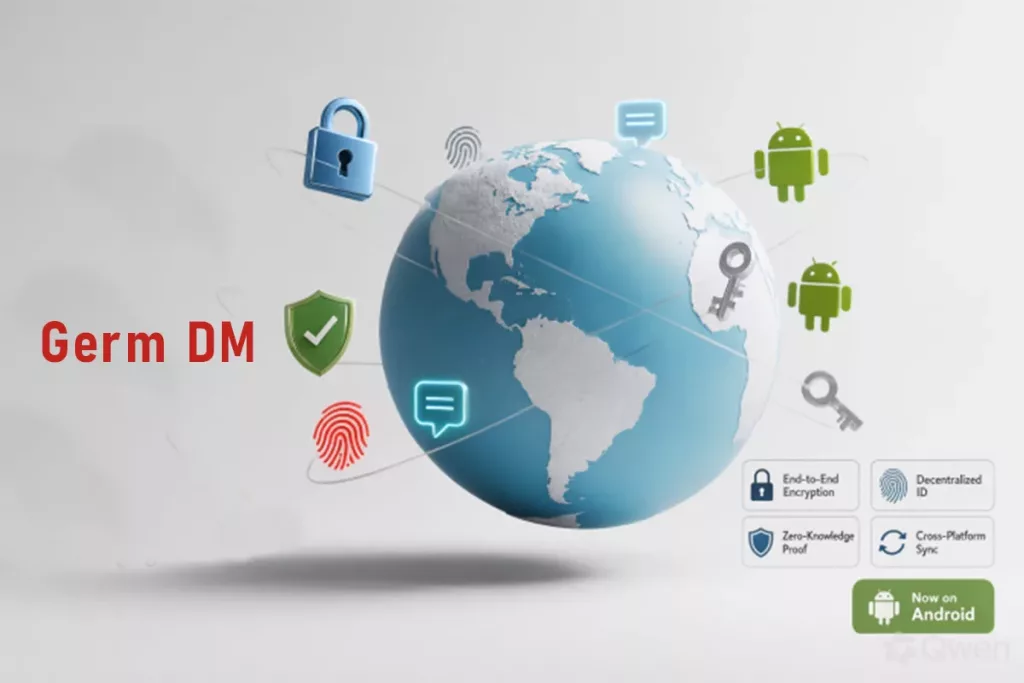
Germ DM, an encrypted messaging application built around user-controlled digital identities, has arrived on Android. Within a day of the launch, the service recorded a reported 20-fold increase in activity, according to co-founder Tessa Brown.
The release marks an important expansion for Germ Network, which first introduced its iPhone application in 2023. The Android version became available on November 18, 2026, opening the service to users who had previously been unable to join conversations because they used a different mobile operating system.
Germ DM offers an alternative to the conventional messenger account. Instead of requiring a phone number or one permanent public username, it allows users to create separate identity cards for different contacts and social contexts. The application also integrates with Bluesky, enabling users to initiate end-to-end encrypted conversations through profiles on the social network.
The launch attracted attention because it addresses two increasingly relevant issues in digital communication: control over personal identity and the protection of private conversations.
However, the reported growth should be interpreted carefully. The 20-fold increase is a figure provided by the company’s co-founder, not an independently audited usage statistic. And while Germ uses an established encryption standard, its security architecture has not yet undergone a formal independent audit.
Why the Android release matters
Germ DM originally launched on iOS in 2023. Its expansion to Android addresses a practical limitation: secure communication is useful only when the people involved can access the same service.
Co-founder Tessa Brown told The Register that users had been asking for an Android version because many of their contacts could not participate in encrypted conversations while the application was available only on iPhone.
Brown also cited Android’s large share of the global smartphone market, estimating it at approximately 70%. This was her explanation of the platform’s strategic importance, rather than an independently verified market-share measurement included in the launch announcement.
According to Brown, Germ’s activity increased 20 times on the day following the Android release. The company has not publicly provided a detailed breakdown of the metric, such as whether it refers to active users, messages, sessions or another measure of activity.
Even with that qualification, the launch is significant for a small messaging platform. It removes one of the barriers to adoption: users no longer need to persuade all their contacts to switch to the same mobile operating system before they can communicate privately.
Identity cards instead of phone numbers
Germ DM’s most distinctive feature is its approach to digital identity.
Traditional messaging applications usually connect a person to a phone number, username or permanent account identifier. That identifier can become a common reference point across professional, personal and social relationships.
Germ takes a different approach. Users can create separate identity cards, each with its own name and photograph. A card can be shared through a direct link or QR code, allowing the recipient to establish a connection without receiving the user’s phone number.
The cards are designed to remain separate from one another. Someone who receives one identity card cannot automatically discover the other cards belonging to the same person.
This creates several possible use cases:
- Professional communication: a person can share a work identity without exposing personal contacts.
- Personal conversations: friends and family can connect through a separate identity.
- Online communities: users can communicate under an identity created specifically for a particular social environment.
- Temporary or limited connections: a card can be shared with someone without giving them access to every other identity used in the application.
Germ’s documentation describes cards as representations of cryptographic keys. Exchanging a card therefore does more than share a display name: it establishes the cryptographic basis for a private connection.
The model gives users greater control over how they present themselves. It does not, however, guarantee anonymity in every situation. A person may still be identifiable through information they voluntarily share, their linked social profiles or details known to the recipient.
How Germ DM protects messages: Messaging Layer Security
Germ DM uses Messaging Layer Security (MLS), an encryption protocol standardised by the Internet Engineering Task Force in RFC 9420, published in July 2023.
MLS is designed to establish encryption keys for private messaging. It supports forward secrecy and post-compromise security, and can be used in conversations involving two or many participants.
In practical terms, end-to-end encryption means that message content is encrypted on the sender’s device and decrypted on the recipient’s device. The service responsible for delivering the encrypted message should not be able to read its contents.
The distinction between encryption in transit and end-to-end encryption is important. A conventional secure connection can protect data while it travels between a device and a server, but the service may still be able to access readable content. With properly implemented end-to-end encryption, the service provider does not possess the keys needed to decrypt the conversation.
Germ’s co-founder Mark Xue previously worked at Apple on privacy engineering for services including iMessage and FaceTime. He says the application relies on standardised cryptography and MLS, while the team has developed its own transport protocol to reduce the metadata generated during message delivery.
Using a recognised standard is a meaningful part of the security design. It does not, by itself, prove that the complete application is secure. Implementation quality, key management, device security and the surrounding infrastructure also matter.
Bluesky integration gives Germ DM a route to new users
Germ’s connection with Bluesky is another important part of its strategy.
Bluesky introduced direct messages on May 22, 2024. At launch, the company explicitly stated that the first version did not include end-to-end encryption, although it planned to support encrypted messaging in the future.
Germ offers a separate encrypted messaging channel for users who want to communicate through the Bluesky ecosystem without relying on its standard direct-message system.
The integration uses AT Protocol, the open protocol underlying Bluesky and other compatible applications. Users can link an AT Protocol identity to a Germ card and display a Germ messaging badge on their Bluesky profile.
This makes it possible to start a protected conversation from a social profile rather than exchanging phone numbers or searching for a separate account.
The integration also helps users discover contacts who have already adopted Germ. The application can use the social connections available through the AT Protocol ecosystem to make it easier to find mutual contacts who are using the service.
There is an important technical distinction here: Germ’s integration with Bluesky is not the same as Bluesky adopting Germ’s encryption system for its own native direct messages. The encrypted conversation takes place through Germ.
The privacy caveat: encryption does not eliminate metadata
Germ’s strongest selling point is its focus on limiting the information available to the service itself. But end-to-end encryption does not automatically hide every detail associated with a conversation.
Metadata can include information about message delivery, destination addresses, connection requests and the timing of activity. Even when message content is encrypted, some operational information may remain visible to the infrastructure handling delivery.
Germ says its custom transport protocol is designed to reduce this exposure. Its technical documentation explains that servers can observe requests for message addresses, the upload of encrypted cards and the sending or retrieval of encrypted messages associated with those addresses. The company says it cannot connect those events to the identities represented by the cards under its described architecture.
This is a narrower and more precise privacy claim than saying that the server sees nothing.
Germ’s published explanation of metadata privacy also acknowledges that an IP address is visible at the network layer, although the company says its server software does not process or store it. The distinction matters because metadata protection depends on the entire technical architecture, not only on the encryption applied to message content.
There is another limitation: the application has not yet undergone a formal independent security audit, according to the developers’ comments reported by The Register. The team has considered such an audit, but it should not be treated as completed.
For users handling sensitive information, this is a material qualification. A recognised cryptographic standard and a privacy-focused design are positive indicators, but independent testing is an important part of establishing confidence in a complete messaging system.
AI features and the challenge of preserving privacy
The Germ founders are also cautious about integrating artificial intelligence into private messaging.
AI-powered tools could help users organise conversations, manage contacts or retrieve information from previous exchanges. However, these features can create a privacy problem if they require message content to be transferred to external servers for processing.
Mark Xue has expressed concern about systems that offer intelligent functionality by sending private conversations to infrastructure controlled by another provider. In that model, the convenience of an AI assistant may come at the cost of exposing information that users expect to remain private.
The development team has indicated that it may consider tools for organising conversations, provided they meet the application’s privacy requirements.
This reflects a broader challenge for the messaging industry: how to introduce AI features without weakening the confidentiality of end-to-end encrypted communication.
For companies handling sensitive customer or financial information, the issue is particularly relevant. Privacy, data governance and the location of information processing are becoming important considerations in the adoption of AI-powered services. FX24 has also examined the wider impact of AI on financial institutions in its analysis of AI-driven changes at JPMorgan and Goldman Sachs.
What comes next for Germ DM?
For now, Germ DM is focused primarily on individual conversations. Group chats are still part of the development roadmap rather than a fully available feature.
The team has also indicated that paid functionality may be introduced in the future. This could provide a revenue model for the service while allowing the core product to expand, although specific pricing and subscription features have not been confirmed.
The immediate priority is likely to be adoption. A messaging platform becomes more useful as more contacts join, and the Android release removes a major obstacle to expanding Germ’s user base.
The longer-term challenge is different: convincing users that its approach to privacy is both technically credible and practical enough to replace familiar messaging habits.
Conclusion: a different model of identity, with security still to prove
Germ DM’s Android release is more than a platform expansion. It introduces a messaging model in which users can manage several separate identities without linking them to a phone number, while using end-to-end encryption to protect message content.
The reported 20-fold increase in activity suggests strong initial interest, although the figure comes from the company and has not been independently verified.
The combination of MLS encryption, a custom transport protocol and Bluesky integration gives Germ a distinctive position in the messaging market. At the same time, the absence of an independent security audit remains an important limitation.
For users, the main attraction is control over identity and access. For the developers, the challenge is to demonstrate that this flexibility can be supported by a transparent and independently tested security architecture.
Germ DM is therefore an interesting development in private communication, but its long-term credibility will depend not only on its privacy claims, but also on how effectively those claims withstand independent scrutiny.
By Jake Sullivan