

Multiple Account Abuse: How Brokers Detect Linked Trading Profiles

One Trader, Five Profiles
Five trading profiles do not necessarily mean five independent clients. One person may operate several accounts to exploit welcome bonuses, repeat prop firm challenges, bypass restrictions or hedge positions against themselves. For a forex broker or proprietary trading firm, detecting this activity requires more than comparing names, email addresses and phone numbers.
Multiple account abuse detection works best when several independent signals are analysed together. Device and session data, network patterns, payment destinations and trading behaviour can reveal relationships that are not visible in individual client profiles. The objective is not to block every account sharing an IP address or device. It is to identify suspicious account clusters, assess the strength of their connections and make decisions that can be explained to compliance teams, clients and auditors.
This guide outlines a practical account-linking framework for brokers and prop firms using MT4, MT5 and supporting risk-management systems. Data collection, retention and enforcement procedures must be adapted to applicable privacy rules, contractual terms and regulatory requirements.
Why Name and Email Matching Is Not Enough
Traditional duplicate-account checks rely on information supplied during registration:
- Full name.
- Email address.
- Phone number.
- Residential address.
- Identification details, where collected.
These fields are useful, but they are not reliable identifiers on their own. Email addresses and phone numbers can be changed. Names may be entered in different formats or transliterations. Prop firms may collect different levels of identity information during evaluation and after a trader qualifies for a funded account.
A system based only on exact profile matches can therefore miss coordinated activity.
Account linking takes a broader approach. Instead of asking whether two profiles contain identical personal information, the system looks for shared infrastructure and repeated behavioural patterns.
For example, two accounts may have different names and email addresses but repeatedly use the same device, withdraw funds to the same beneficiary and execute closely matched trades. Each observation contributes to a wider picture.
The result is a relationship graph: accounts are represented as nodes, while shared attributes create connections between them. The strength of each connection depends on the reliability and context of the underlying signal.
A useful model has two principles:
- Explainability: investigators should be able to identify the exact signals that connected the accounts.
- Risk-based action: a single weak match should not automatically trigger a suspension or confiscation of funds.
In monitoring environment, account relationships become another risk input alongside exposure, trading anomalies and potentially toxic order flow.
Build an Account-Linking Graph: Five Types of Signals
A practical detection model can be divided into five categories. Each category provides a different perspective on the relationship between accounts.
| Signal category | Examples | What it can reveal |
| Identity | Name variations, date of birth, address, document details | Possible identity overlap |
| Device and session | Device fingerprint, OS/browser configuration, application identifiers | Repeated use of the same device or environment |
| Network | IP address, ASN, ISP, VPN/proxy indicators, location patterns | Shared or coordinated network access |
| Payments | Tokenised card details, wallet addresses, bank accounts, payout beneficiaries | Common funding or withdrawal destination |
| Trading behaviour | Order timing, position management, opposite positions, EA patterns | Coordinated trading activity |
Not all connections have equal evidential value.
A shared payout destination may be more meaningful than a shared public IP address. A repeated combination of device, payment and trading signals may be more persuasive than any one of them in isolation.
The objective is to identify clusters with multiple consistent connections, rather than treat every shared attribute as proof of abuse.
- Device and Session Signals: Identify Repeated Infrastructure
Device and session telemetry can provide some of the most useful account-linking signals. Unlike registration details, these characteristics may remain consistent across multiple sessions and profiles.
A monitoring system can examine:
- Device fingerprints: combinations of hardware and software characteristics used to recognise a device or browser environment.
- Operating system and browser configuration: recurring technical patterns across different accounts.
- Application instance identifiers: where mobile applications use identifiers that can lawfully be collected.
- Persistent cookies: where their use is permitted and properly disclosed.
- Repeated account creation: several new profiles created from the same device within a short period.
- Unusual device changes: repeated switching between devices, particularly around sensitive account actions such as withdrawals.
Device fingerprints should be treated as probabilistic identifiers, not guaranteed unique identifiers. Several legitimate users may share similar configurations, while one person can deliberately change devices or browser environments.
A useful way to strengthen the signal is to combine it with behaviour. The same device accessing several accounts is one observation. The same device accessing those accounts while they execute highly similar trades is a stronger reason for investigation.
Brokers should also maintain an approved-device or trusted-environment list where appropriate. For example, institutional clients may legitimately access accounts from shared corporate infrastructure.
Privacy consideration: device data collection must be consistent with the organisation’s privacy policy, applicable consent requirements and data-protection rules, including the GDPR where relevant. Data minimisation, access controls and retention periods should be defined before monitoring is deployed.
- Network and Geolocation Signals: Look for Patterns, Not Just IP Matches
IP-address matching is a familiar fraud-detection technique, but it is easy to misinterpret.
A single IP address can be shared by family members, office employees, university networks, coworking spaces or clients using the same internet provider. Conversely, a person operating multiple accounts may use VPNs, proxies or mobile connections to make network patterns less obvious.
More useful indicators include:
- Repeated access from the same ASN and city: particularly when several accounts log in regularly from the same network environment.
- VPN, proxy or Tor indicators: especially when they coincide with sensitive account activity.
- Unusual location changes: rapid transitions between geographically distant locations that are inconsistent with plausible travel.
- Repeated IP rotation: several supposedly unrelated accounts switching between a small set of IP addresses.
- Event-based anomalies: a withdrawal request from a new country combined with a new device or an unusual authentication pattern.
The key is to avoid treating network overlap as a verdict.
A shared IP address should normally be a supporting signal, not an automatic reason to block an account. A combination of the same IP, recurring device characteristics and correlated trading activity deserves closer review.
- Payment and Withdrawal Links: Follow the Beneficiary
Payment relationships can provide particularly useful evidence because money transfers may reveal connections that are not apparent in registration data.
A trader can create several email addresses, but repeatedly routing withdrawals to the same bank account or wallet can expose a common financial destination.
Monitor the following patterns:
- Shared payout destinations: the same bank account, IBAN, tokenised card or e-wallet used by multiple profiles.
- Beneficiary-name inconsistencies: repeated withdrawals to third parties, especially across several accounts.
- Deposit and withdrawal cycles: multiple accounts funded with smaller amounts, followed by transfers to a common destination.
- Card and payment-token overlap: repeated use of the same tokenised payment instrument, considered alongside other evidence.
Payment monitoring should distinguish between a shared funding source and a shared beneficiary. They may have different implications under the broker’s policies and applicable rules.
Practical controls include:
- Apply beneficiary-name matching where legally and operationally appropriate.
- Require additional verification when a client changes a withdrawal destination.
- Introduce risk-based review periods for first withdrawals or newly added payment methods.
- Maintain an audit trail showing who approved a payment and why.
- Reconcile payment records with the broker’s client and trading-account records.
A common payout destination can be a strong linking signal, but it does not automatically prove that the account holders are the same person. Family members, business partners and authorised representatives may have legitimate reasons for shared payment arrangements. Those cases need documented review.
- Trading Behaviour: Detect the Same Strategy Across Different Profiles
In FX/CFD brokerage and prop trading, trading behaviour can reveal relationships that profile data does not.
A trader may use different devices, IP addresses and payment methods. Reproducing the same detailed execution patterns across several accounts can be more difficult.
Useful behavioural indicators include:
Mirrored order execution
Several accounts repeatedly place orders in the same instruments within milliseconds or seconds of one another. The pattern becomes more significant when it recurs across multiple sessions and is supported by other signals.
Identical position management
Accounts display similar stop-loss and take-profit distances, partial-close patterns, holding periods and position-management sequences.
Automation fingerprints
Repeated grid intervals, lot-size progression, execution timing or other persistent characteristics may indicate the use of the same automated strategy or configuration.
Opposite-side coordination
Several accounts repeatedly hold opposing positions in the same instruments. Depending on the circumstances, this may indicate self-hedging or coordinated activity between accounts.
However, similar trading behaviour is not proof of common ownership. Traders may follow the same signal provider, use copy trading, trade popular strategies or react similarly to major market events.
The broker or prop firm must distinguish permitted strategy replication from prohibited multi-account activity. Its terms, evaluation rules and appeal procedures should define the difference.
A practical analysis sequence is:
- Identify clusters with correlated trading patterns.
- Compare those clusters with device and session data.
- Check payment and withdrawal relationships.
- Review the timing and consistency of the connections.
- Document the evidence before taking action.
- Turn Linking Signals into a Risk Score
Collecting data is only the first step. A useful detection system must translate observations into consistent decisions.
A risk-scoring model can assign different weights to signals according to their reliability, context and relevance to the suspected abuse.
For example:
| Signal | Illustrative interpretation |
| Same email address | Direct profile overlap; verify account ownership |
| Same public IP | Weak by itself; investigate shared-network context |
| Similar device fingerprint | Supporting evidence; check recurrence |
| Same payout beneficiary | Stronger financial connection; verify authorisation |
| Repeated mirrored trades | Behavioural connection; compare timing and execution details |
| Same device + common payout + correlated trades | Multiple independent links warrant detailed investigation |
These are qualitative examples, not universal numerical weights. A broker should calibrate its own model using historical cases, confirmed abuse, false positives and the characteristics of its client base.
A useful principle is to distinguish between:
- Hard signals: relatively specific links, such as a verified common payout beneficiary.
- Soft signals: contextual indicators, such as a shared IP address or similar device configuration.
Even a strong signal may require additional context. The system should record not only the risk score but also the underlying observations and the reason for any decision.
- Monitoring
Account-linking logic becomes operationally useful when it is connected to the broker’s client records, trading data and risk-management workflow.
A monitoring environment should ideally provide:
- A consolidated view of related accounts.
- Shared device, network and payment attributes.
- Trading-correlation indicators.
- Risk scores and alert priorities.
- Case notes and supporting evidence.
- A record of analyst decisions and subsequent outcomes.
What Is risk-management platform and How Does It Extend Account Monitoring?
A risk-management platform category designed for forex brokers, prop firms and other financial companies. It is an operational tool for the broker’s dealing desk and risk team, not a trading strategy or a retail trading application.
Its role can extend beyond identifying suspicious account relationships.
Toxic flow detection
Risk-management systems may combine rule-based monitoring with AI-assisted analysis to flag trading patterns that require further review. Depending on the system and its configuration, these may include:
- Latency arbitrage and attempts to exploit quote delays.
- Aggressive scalping with unusually short holding periods.
- News trading patterns that exploit pricing or execution conditions.
- Martingale, grid and averaging strategies.
- Bonus abuse and suspected multiple-account activity.
- Suspicious network indicators, including VPN, Tor and proxy usage.
A-Book, B-Book and hybrid risk allocation
Functionality may also extend to execution-book management:
- A-Book: client trades are passed to external liquidity providers, commonly through an STP model.
- B-Book: the broker retains the market risk associated with client positions.
- C-Book / Hybrid: the broker combines internalisation and external hedging according to its execution and risk-management model.
Depending on the system, routing decisions may be automated or governed by predefined rules. Client risk profiles and current exposure can form part of that decision-making process.
For multiple-account detection, the important point is that related accounts should not always be assessed in isolation. Their combined positions, trading patterns and exposure may create a different risk profile from that of each account viewed separately.
Hedging rules and exposure limits
A risk-management platform can support predefined hedging triggers and exposure limits. Examples include:
- Hedging rules based on net exposure.
- Gradual hedging levels, such as 0%, 25%, 50% and 80–100%.
- Limits on drawdown and daily losses.
- Controls for excessive concentration in a particular instrument, symbol or currency.
These percentages are illustrative configuration examples, not universal industry standards. Each broker needs to calibrate thresholds against its execution model, liquidity arrangements, risk appetite and applicable requirements.
Risk controls for prop firms
For prop firms, the same approach can be applied to challenge and funded accounts. Depending on the platform’s capabilities, controls may include automated monitoring of challenge rules, detection of daily and maximum drawdown breaches, and restrictions when predefined limits are violated.
Risk monitoring may also help investigate suspected copy trading, signal-service use and coordinated multiple-account activity. However, legitimate copy trading and prohibited account sharing are not necessarily the same thing. The firm’s rules must define the distinction and provide a review process.
How risk-management platform complements multiple account detection
The distinction is between identifying a relationship and measuring its operational impact.
Linking signals help establish whether several profiles may belong to the same person or coordinated group. Risk-management monitoring adds another layer: it helps the broker assess the combined positions, P&L, exposure and trading patterns associated with those profiles.
A practical process can therefore follow three stages:
- Detect: identify links through device fingerprints, network activity, payment relationships and correlated trading behaviour.
- Assess: combine the evidence with account-level and aggregate exposure data, using a documented risk-scoring methodology.
- Act: apply proportionate controls, request additional verification or escalate the case for compliance review, in line with the broker’s policies and applicable rules.
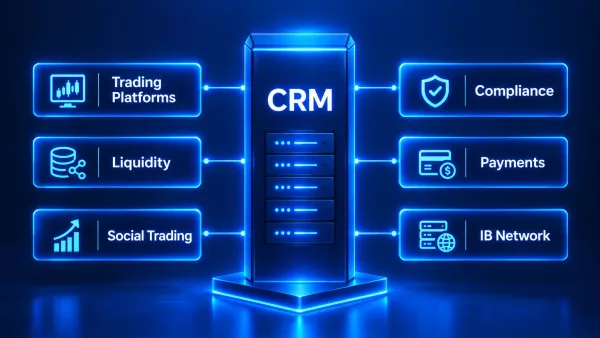
For brokers using MetaTrader, integration between platform data, CRM and risk tools is important. Account identifiers, order history, transaction records and client status need to be associated consistently.
The provider websites supplied for this article describe several relevant technology categories:
- TradeToolsFX lists MT4/MT5 CRM, custom API development, multi-account tools, a risk-management product category and broker technology integrations.
- MetaTraderProvider.io lists MT4/MT5 white-label and grey-label services, A-Book integration, data feeds and a MetaTrader Prop Firm Match offering. Platform infrastructure can provide the environment in which account and trading data are collected and managed.
- TSG Server’s MetaTrader API integration page is a relevant reference for the integration layer. The exact page could not be independently retrieved during this review, so its current technical scope should be confirmed directly with the provider.
The right architecture depends on the broker’s platform, CRM, payment providers, data availability and internal risk procedures. A list of tools is not a substitute for a documented data model and clear case-management rules.
For further context on account-management technology, see FX24’s guide: MT4 vs MT5 in Account Management: Which MAM Plugin to Choose — And Why It’s Not Just a Marketing Question.
- Create an Explainable Investigation and Escalation Workflow
The most common operational weakness in multi-account detection is inconsistent decision-making. One analyst may suspend an account based on a shared IP address, while another may ignore a cluster containing several stronger connections.
A documented workflow helps prevent arbitrary outcomes.
Step 1: Assess the relationship
Review the available signals and classify their strength. Compare payment, device, network, identity and trading data rather than relying on a single match.
Step 2: Assign a risk level
A practical three-level model can structure the response:
| Risk level | Typical response |
| Low | Add accounts to a watchlist and increase monitoring |
| Medium | Review sensitive actions, such as bonuses, challenge resets or withdrawals, in line with the firm’s rules |
| High | Escalate for compliance review, request supporting documentation and apply proportionate restrictions where contractually and legally permitted |
A risk level should initiate a review, not replace it.
Step 3: Record the evidence
An investigation note should identify the shared attributes and explain why they matter.
For example:
The accounts share a recurring device fingerprint and a verified payout beneficiary. Their trading histories also show repeated mirrored execution in the same instruments. The combination has triggered a high-priority review.
This is more useful than a generic note stating that the accounts “look suspicious”.
Step 4: Apply proportionate measures
Depending on the evidence, applicable rules and the firm’s terms, actions may include enhanced monitoring, additional verification, a request for an explanation or temporary restrictions on specific account functions.
Suspension, payout restrictions or account closure should follow documented procedures and the relevant contractual and regulatory requirements.
Step 5: Close the feedback loop
Classify each completed case as confirmed abuse, legitimate shared activity or inconclusive. Feed those outcomes back into the model.
This helps adjust signal weights, reduce false positives and improve the quality of future investigations.
- A Practical Checklist for Brokers and Prop Firms
Before deploying a multiple-account detection process, verify the following:
Define what constitutes prohibited multi-account activity in client agreements and prop firm rules.
Identify which account, identity, device, network, payment and trading fields are available.
Establish a consistent account identifier across CRM and trading systems.
Document the lawful basis and permitted purposes for collecting device and session data.
Define data access, retention and deletion rules.
Separate hard signals from contextual indicators.
Set risk thresholds and escalation responsibilities.
Create a case record with evidence, timestamps and analyst decisions.
Define procedures for client explanations and appeals.
Review false-positive and confirmed-abuse cases regularly.
Test integrations and data consistency between the CRM, MetaTrader and risk-management tools.
A detection system should be evaluated not only by the number of suspicious accounts it identifies, but also by how accurately it distinguishes abuse from legitimate shared environments.
Conclusion: Detect Account Relationships, Not Just Duplicate Profiles
Multiple-account abuse is a relationship problem, not simply a registration-data problem. A trader can change an email address, use another device or connect through a different network. But repeated links across payment destinations, session characteristics and trading behaviour may still reveal a coordinated cluster.
For brokers and prop firms, the most reliable approach combines several independent signals, assigns risk proportionately and keeps every decision explainable. Device fingerprints, IP addresses and trading correlations should support an investigation, not become automatic grounds for punishment.
Risk-management platform adds an operational layer by connecting account relationships with exposure, P&L, trading-risk indicators and execution-book management. The objective is to identify suspicious activity early, protect the integrity of trading and evaluation rules, and preserve a fair process for legitimate clients.
By Ethan Blake